

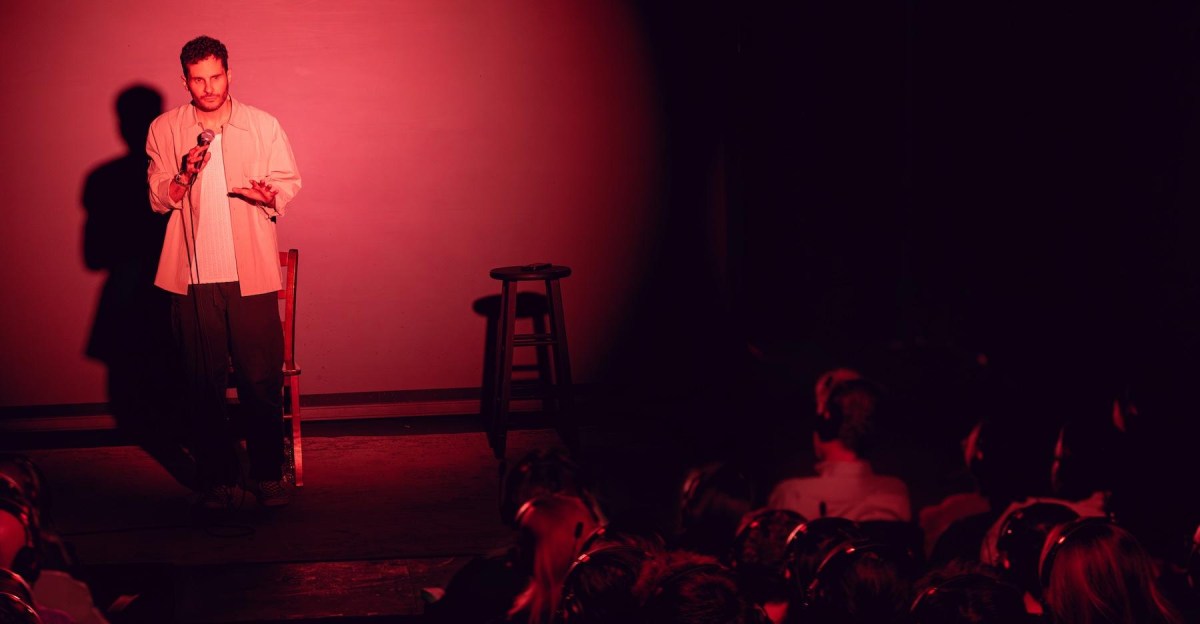
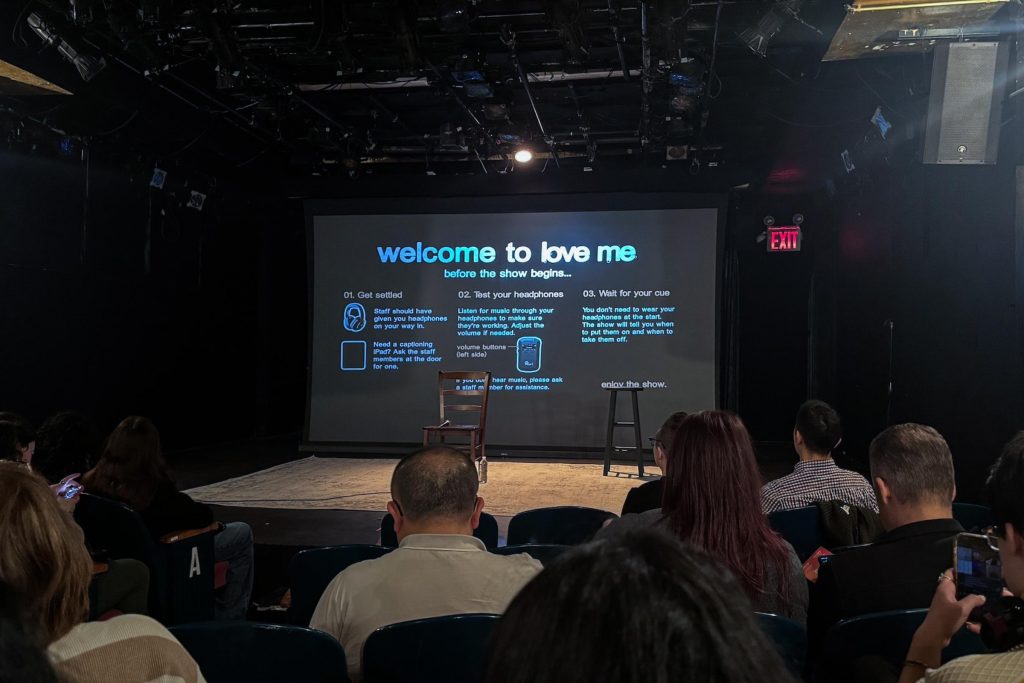
Auracast headphones are at the center of Love Me, a one-man show at the 178-seat SoHo Playhouse in New York City that uses a Bluetooth-based broadcast to shape how the audience hears the performance. Audience members receive wired headphones connected to a small Auracast receiver and are told to put them on shortly after the play begins.
The show is written by stand-up comedian and former Saturday Night Live writer Drew Michael, with direction from Prashanth Venkataramanujam. It runs in five chapters about different relationships in Michael’s life, linked by his hearing loss and his path toward self-discovery. The show’s central theme is love and the search for connection.
How auracast headphones make the sound design work
Auracast is a feature built on Bluetooth that can broadcast a high-quality audio stream to any number of nearby devices at once. That capability is what makes the production possible. Sound designer Daniel Kluger combines the headphones with the theater’s speakers to create effects that would not be possible with a standard setup.
As the show moves from Michael’s childhood into adulthood, tinnitus ringing and hearing test tones play in the music between sections. These sounds act as subtle clues that build toward Michael’s realization about his hearing loss. Kluger also uses changing levels of clarity to put the audience inside Michael’s perception. Sound from the theater speakers is sometimes intentionally muffled, and the auracast headphones dull it further, so the audience gets a sense of what Michael hears at those moments.
Inner monologue stays clear through the headphones
One sound stays clean throughout the performance. Michael’s inner monologue is delivered through the headphones and combines prerecorded tracks with a live feed from his microphone as he talks back and forth with himself. Michael said after the show that anything in the headphones comes through clearly, and that the inner world is the highest fidelity space for him because it feels more comfortable.
The layering can make some scenes deliberately hard to follow. In one sequence, Michael performs a stand-up set at a comedy club while three sound sources compete for attention. The theater speakers play the crowd’s reactions, including a heckler whose voice is sometimes muffled and sometimes clear. His prerecorded inner monologue reacting to the crowd plays in the headphones, while his on-stage microphone is muffled so the focus stays on his internal voice. Audience members have to work to follow what is happening, and the sound can feel overwhelming.
Removing the headphones marks the emotional climax
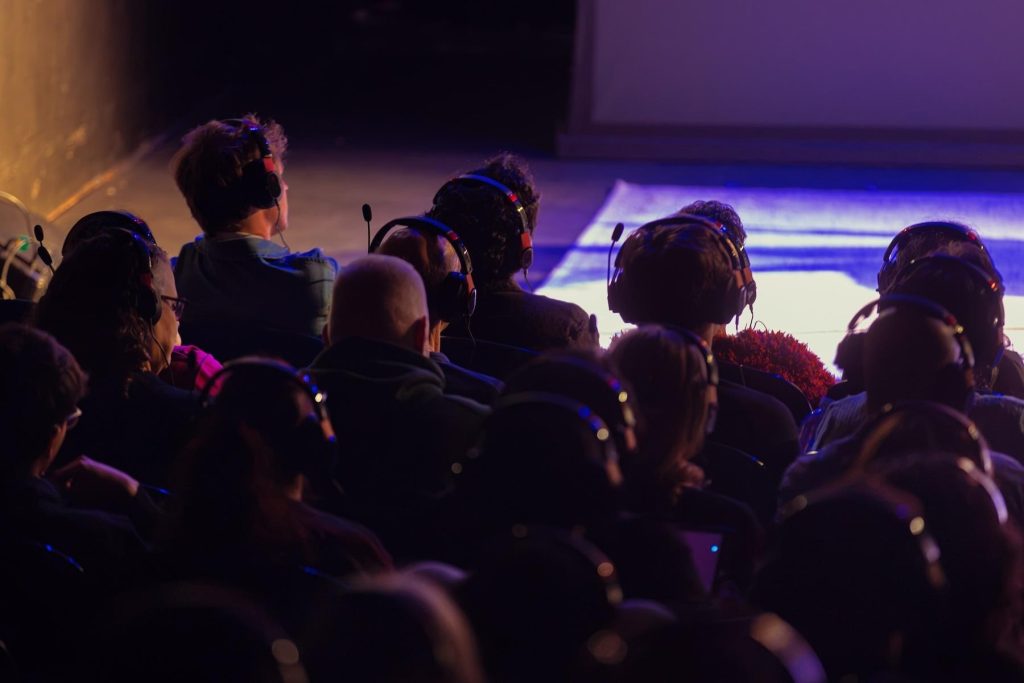
The strongest effect comes in a climactic scene that incorporates visuals of a series of Michael’s audiograms collected over the years. In that moment Michael describes a breakthrough about what he calls the cognitive labor that affected every minute of his life. The audience is then told to take off the headphones they have worn for nearly the entire show.
Removing the headphones is a deliberate choice. The audience loses the sound layer it has relied on, and the clarity of mind Michael reaches in that scene is mirrored by the sudden absence of the device. The final act follows from this, as Michael works through his own Deaf identity. Michael said, “The deafness is not the culprit, it’s the denial of it.”
Connecting auracast headphones to the audience feed
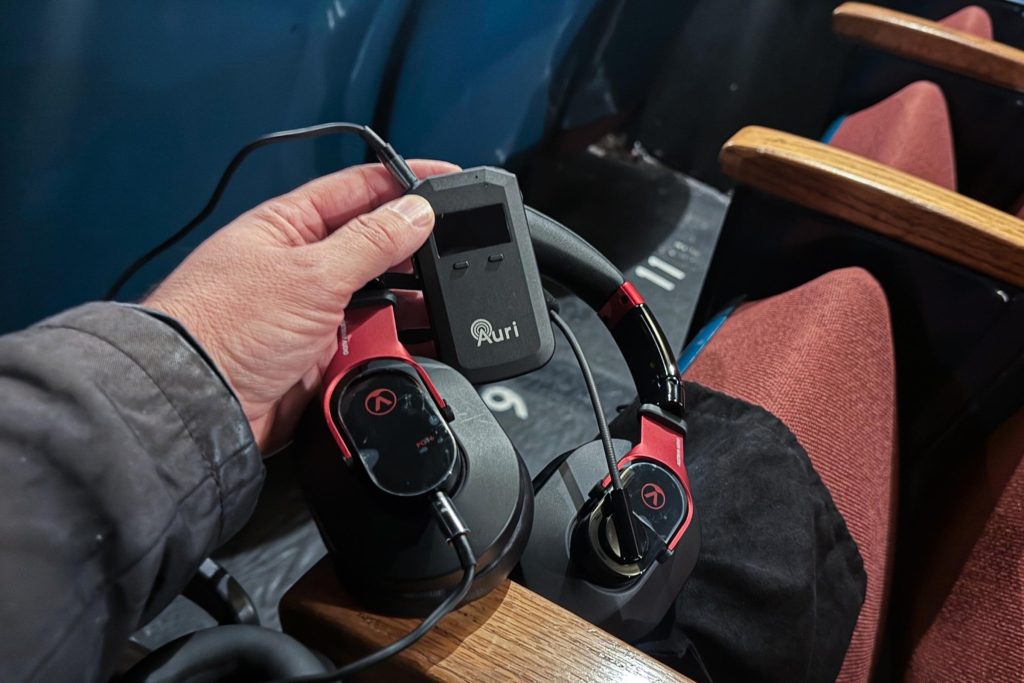
Any Auracast headphones can connect to the audience broadcast, which is why the production could be staged this way. In one test, a Nothing Pro 1 pair connected to the audience channel within seconds. For the performance itself, the production supplied an Auri receiver and Austrian Audio headsets, and the show’s sound was designed with that equipment in mind, since differences in isolation between headphone models can change how the mix lands.
Accessibility feeds for hearing aids and captions
Love Me is presented in partnership with Deaf West Theatre, a company that supports Deaf-centered storytelling in theatrical productions. Besides the main audience feed, a second Auracast channel is designed for users of hearing aids and cochlear implants and is built to work with those devices. iPads displaying captions are also available.
During the performance, Michael connects to his own broadcast channel using Auracast-enabled Phonak Eon Sphere hearing aids. He said the team considered in-ear monitors but rejected them because they would cut off amplification from the room and break his contact with the audience. In his words, the hearing aids work as both hearing aids and in-ear monitors.
Why the technology serves the story about Deaf identity
Michael says the show is not about hearing technology. He describes a tension between the hearing aid and audiological side of deafness and the cultural identity side. Technological advances such as cochlear implants and hearing aids are cited as one reason schools for the deaf have declined, which leads to many children being mainstreamed into regular public schools and missing out on Deaf history and culture. Michael said, “I’m not against the tech,” and added that tech and Deaf identity should be a marriage rather than a divide.
The Auracast system serves two purposes. It provides accessibility, in the same way the technology is already used in other performances, lectures and announcement systems. It also supports the show’s story about love, acceptance and acknowledgment of one’s own Deaf identity. The production shows how a broadcast audio standard built for everyday devices can become a storytelling tool, and whether other theaters adopt the same approach will be the next thing to watch.