

Google has posted a job listing for a Senior Software Engineer on its Discover Feed Recommendations team, and the description mentions several internal terms that have not been publicly explained. The most unusual is Google StarSearch, a system the listing describes as a gatekeeper for Discover content. Other terms include AIGC, zero-history discovery and Feed Ranking.
What the job listing says about Google StarSearch
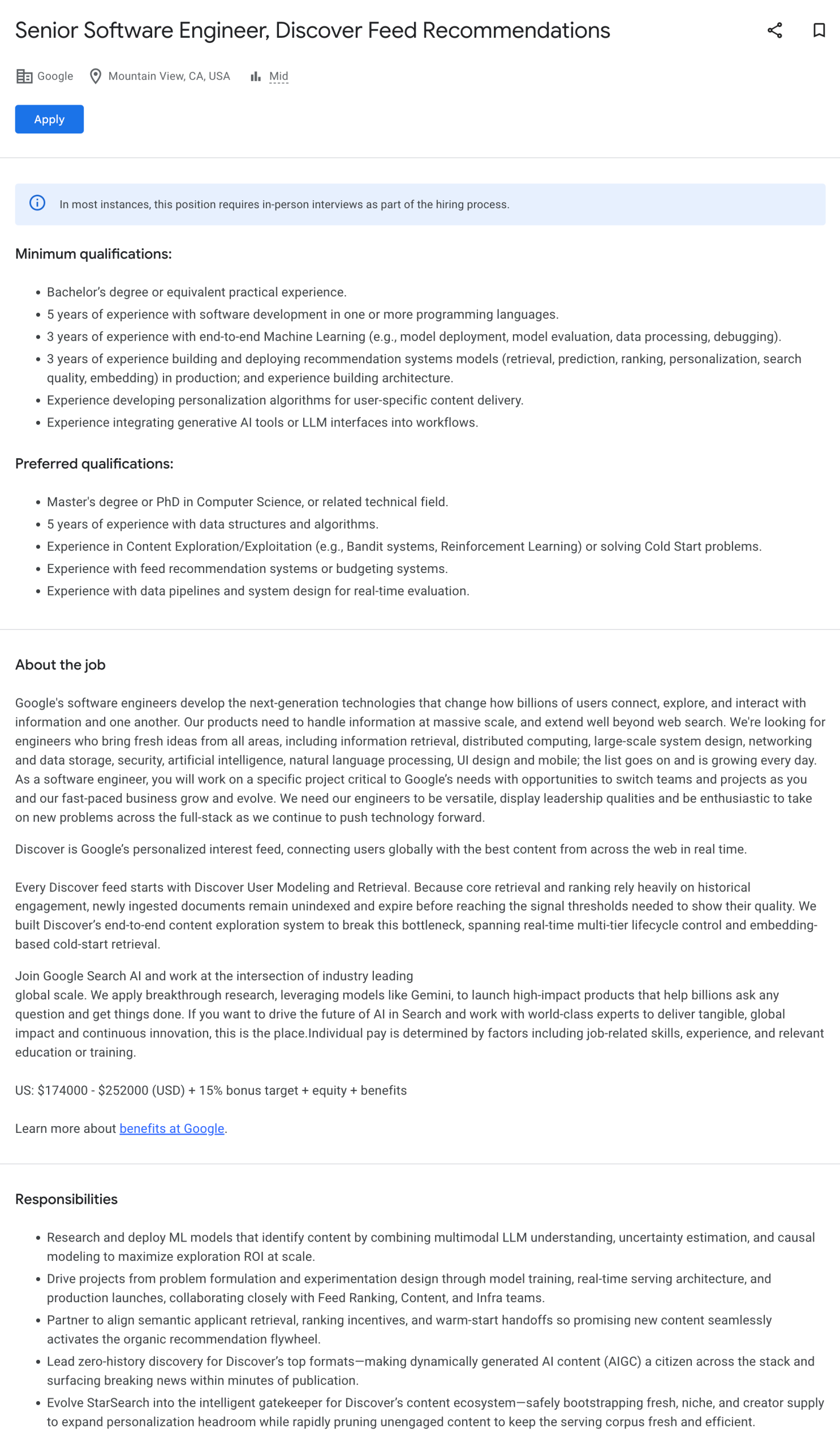
The listing gives the role’s main responsibility as evolving StarSearch into what Google calls “the intelligent gatekeeper for Discover’s content ecosystem.” The same line says the work involves safely bootstrapping fresh, niche and creator supply to expand personalization headroom, while rapidly pruning unengaged content to keep the serving corpus fresh and efficient.
Google does not publicly describe StarSearch in its help documentation or product announcements, and a search across Google and several AI tools turned up no other information about it. The job posting is the only public source that names the system.
Damien Andell, who spotted the listing, wrote on X that the term appears in pipeline names, including “discoverhighlightsstarsearch” and “AURA_STARSEARCH.” His working theory was that StarSearch serves ultra-low-traffic content, and he said the job description appears to confirm that idea.
The cold-start problem in Google Discover
Discover is Google’s personalized interest feed, which shows users content from across the web in real time. The listing explains that every Discover feed starts with user modeling and retrieval, and that core retrieval and ranking depend heavily on historical engagement.
That creates a problem for new pages. According to the listing, newly ingested documents can remain unindexed and expire before they collect enough engagement signals to show their quality. Google says its end-to-end content exploration system is meant to break this bottleneck, using real-time multi-tier lifecycle control and embedding-based cold-start retrieval.
AIGC and zero-history discovery
The listing says the engineer will lead “zero-history discovery” for Discover’s top formats. Zero-history content is material that has no traffic or engagement record yet, such as a page indexed moments ago. The posting says this work involves “making dynamically generated AI content (AIGC) a citizen across the stack” and surfacing breaking news within minutes of publication.
The role also covers research and deployment of machine learning models that identify content by combining multimodal large language model understanding, uncertainty estimation and causal modeling. The listing says these models should maximize exploration return on investment at scale. The engineer would also align semantic retrieval, ranking incentives and warm-start handoffs so that promising new content can move into the regular recommendation system.
Qualifications and pay for the role
The listing is for a position in Mountain View, California, and says in most instances the job requires in-person interviews. Minimum qualifications include a bachelor’s degree or equivalent practical experience, five years of software development experience, and three years each of building machine learning systems and recommendation systems. Preferred qualifications include a master’s degree or PhD in computer science, experience in content exploration or cold-start problems, and familiarity with data pipelines and system design for real-time retrieval.
The screenshot of the listing shows a pay range of US $174,000 to $252,000, plus a 15% bonus target, equity and benefits. Google says individual pay depends on job-related skills, experience and education or training.
The listing does not say when Google plans to launch any of these systems, and it does not confirm how StarSearch works. For now, the job posting is the main public clue to how Google may handle new and low-traffic content in Discover.