

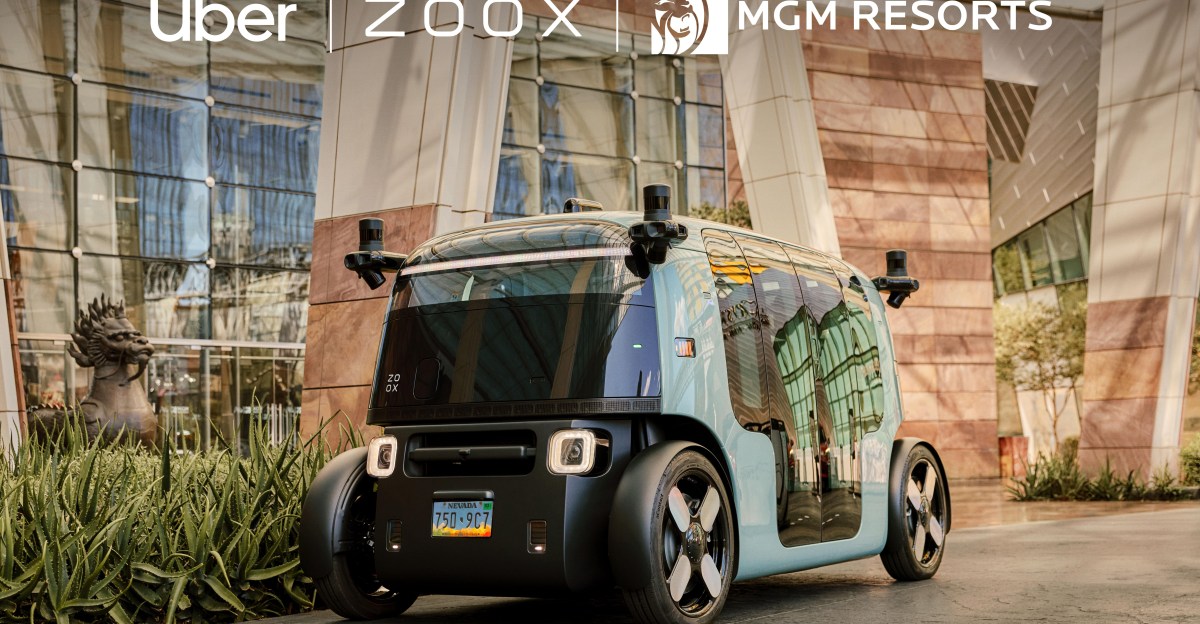
Zoox robotaxis are now available through the Uber app in Las Vegas, giving riders in the city a chance to be matched with Amazon-owned autonomous pods. The launch is a first for both companies, marking the first time Uber has added a purpose-built vehicle without a steering wheel to its network and the first time Zoox has opened its fleet to a third-party app.
Zoox robotaxis join Uber’s Las Vegas lineup
Uber said riders in Las Vegas can now be matched with Zoox vehicles as part of the company’s standard ride options. The Zoox pods are purpose-built, bidirectional robotaxis, meaning they are designed to drive in either direction without turning around. Because they have no steering wheel, they are fully autonomous vehicles with no human driver on board, which sets them apart from the conventional cars that make up most of Uber’s network.
The integration gives Uber a new type of vehicle to offer alongside its human-driven fleet. Zoox is also keeping its standalone app running, so the company will continue to operate independently alongside the Uber integration. Riders who book through either platform can reach the same fleet, although the two services are separate products.
Uber has been adding autonomous partners to its app for some time. The company’s strategy has moved away from building its own self-driving technology and toward acting as a marketplace for many robotaxi operators. That approach brings in larger players and smaller ones alike, and the Zoox launch extends the list.
How riders can get matched with a pod
Uber said that anyone ordering an UberX, Uber Comfort, Uber Electric, Uber Comfort Electric, or Wait & Save ride in Las Vegas can be matched with a Zoox at no extra charge. Riders do not pay a premium for the autonomous option, so the fare is the same as the standard product they selected.
Matching is not guaranteed. Like Uber’s other autonomous partnerships, including the ones with Waymo in Phoenix and Austin, riders can turn on a preference in the app’s Ride Preferences settings. Enabling that option increases the chance of being paired with an autonomous pod, but the app does not promise a robotaxi on every request.
The setting is a useful tool for riders who want to try the driverless service. Those who prefer a human driver can leave the preference off and continue to receive standard matches.
MGM Resorts partnership targets casino pickup chaos
Alongside the launch, Uber and Zoox announced a multiyear deal that makes them the official rideshare and robotaxi partners for MGM Resorts International in Las Vegas. Resort pickup zones at properties such as the Bellagio and MGM Grand are busy areas where valets, idling tour buses and tourists all share the same space. For autonomous vehicles, those crowded entrances are difficult to map and navigate.
To keep Zoox pods from getting stuck in traffic loops at the resorts, the companies say the partnership goes beyond branding. MGM, Uber and Zoox are rolling out physical infrastructure changes, including clearer on-property wayfinding. They are also adding custom in-app guidance meant to make pickups and drop-offs work better for driverless cars.
The arrangement shows how robotaxi operators depend on the places where riders are picked up, not just on the roads between them. Clear signage and app guidance can help an autonomous vehicle find the correct pickup spot without relying on a human driver to flag down the rider.
Los Angeles is the next target
Uber and Zoox are already looking beyond Las Vegas. Zoox plans to launch initial standalone operations in Los Angeles through its own app before the end of 2026. A full Uber integration in the city is planned for sometime in 2027.
The Zoox service has geographic limits in Las Vegas. Its robotaxis cover heavy tourist zones, including the Strip, downtown Las Vegas and the Arts District. That is a narrower footprint than a human driver offers, since drivers can take riders across the whole metropolitan area.
Those limits are typical of early robotaxi deployments, which usually begin in areas with mapped roads, predictable routes and high demand. Expanding into Los Angeles will test how the service performs in a larger and more congested city.
Uber’s autonomous strategy and Waymo’s exit
Uber’s autonomous push is not without setbacks. Waymo co-CEO Tekedra Mawakana recently announced an end to the company’s exclusive partnership with Uber in Austin and Atlanta, which will take effect by January 2028. Mawakana described the arrangement as a “crapshoot.”
The Waymo change shows the trade-offs of Uber’s model. A marketplace with many autonomous partners can spread risk across operators, but it also means that individual robotaxi companies may choose to run their own apps or partner with other platforms. For riders, the practical result is a growing number of autonomous options inside a single app, with availability that depends on the city and the operator.
The next milestones to watch are the Zoox standalone launch in Los Angeles before the end of 2026 and the planned Uber integration in 2027.