

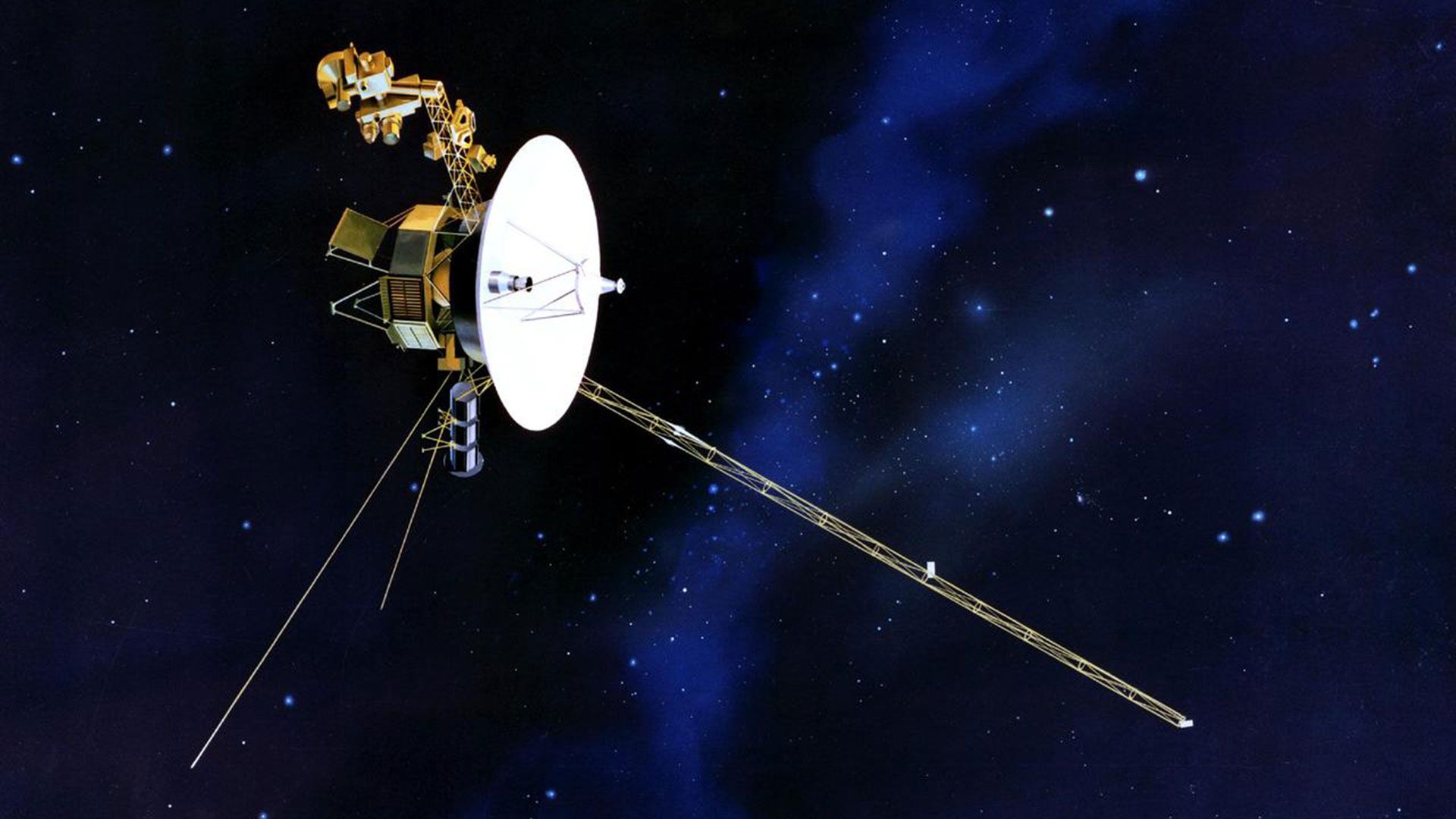
Voyager 1 is the first human-made object to reach a distance of one light-day from Earth, NASA has confirmed. The spacecraft crossed the threshold just after 5 am ET on Wednesday, November 18, marking 49 years since its launch in 1977. At that point, a signal sent from Voyager 1 takes a full 24 hours to reach Earth.
Voyager 1 crosses a distance measured in light
A countdown tracker showed the spacecraft passing the milestone while travelling at about 37,844 mph. Voyager 1 is now more than 16 billion miles away, or about 26 billion kilometers. Over the last half century, the probe has been moving at a cruising speed of roughly 38,000 mph, which has gradually carried it into the outer reaches of the solar system.
Distances in space are hard to picture in miles, so astronomers often describe them in terms of how long light takes to cover them. Light travels fast enough to circle Earth several times in a single second, yet the gaps between worlds are so large that its journey can still take hours or days. Voyager 1 is now far enough out that a radio signal needs an entire day to make the trip.
How one light-day compares with nearby worlds
NASA has provided a set of reference points to put the figure into context. The Moon is 238,855 miles from Earth, or about 1.3 light seconds away. The Sun, roughly 93 million miles distant, sends its rays to Earth in about 20 light seconds.
Mars is a closer comparison for planetary travel. Because the two planets follow their own orbits around the Sun, the time light takes to travel between them varies widely, from about three minutes to as long as 22 minutes. Voyager 1 now sits on the brink of being a full light-day away, a distance that dwarfs any of these everyday references.
- Moon: 238,855 miles, about 1.3 light seconds
- Sun: about 93 million miles, about 20 light seconds
- Mars: light takes roughly three to 22 minutes to cross the gap, depending on orbital positions
- Voyager 1: more than 16 billion miles, a signal needs 24 hours

What Voyager 1 still has ahead
The milestone does not mark the end of the mission. NASA says Voyager 1 is on course for an obscure star called Gliese 445, which sits in the constellation Ursa Minor. The spacecraft will need about 40,000 years to reach the star’s position, so no crew or observers will be celebrating a flyby anytime soon.
The probe continues to send back data from its instruments as it moves further from the Sun. Its distance means every command sent from Earth and every reply takes many hours to complete, a constraint that has shaped how the team operates the aging spacecraft.
The Golden Record and a global signal event
Voyager 1 carries a copy of the Golden Record, a gold-plated disc of sounds, music and images meant to show the diversity of life and culture on Earth. NASA scientists launched the probe with the hope that someone, somewhere, would one day find and play it. Any finder would also need a way to play the record, which is why the disc is often described as a message in a bottle.
NASA has also invited space enthusiasts to take part in a global event called Golden Light. Participants are asked to flash the three-letter call sign for the Voyager mission, VGR, into the night sky in Morse code using their phone flashlights. A website is available to flash a screen in the same pattern. The event is designed to mark the milestone with a visible, shared gesture from people on the ground.
The milestone adds to the long record of a mission that has outlasted its original plans by decades. Voyager 1 will keep moving outward, and each new distance marker will come with the same reminder of how far a small probe built in the 1970s has travelled.