

Trezor has confirmed that three Trezor Safe 5 hardware wallets sold by the Southeast Asian reseller CryptoBilis contained malicious hardware implants designed to steal wallet recovery phrases and send them to attackers over cellular networks. The company also released a firmware update that blocks the implants from capturing data on devices that run it.
How the investigation unfolded
The case began in October, when a customer found an unauthorized circuit board inside a Trezor Safe 5 bought from the Indonesian reseller CryptoBilis. At that time, Trezor had not received the device and could not confirm what the implant was able to do.
In a new investigation update, Trezor said it has now examined the original device in its laboratory. The company also identified two additional compromised wallets using photographs submitted by their owners. All three compromised devices were purchased from CryptoBilis between August 20 and September 23, 2026.
Trezor said 48 CryptoBilis customers have contacted the company since its October warning. Those devices were checked either in the lab or through photos of their internal components. The company also inspected devices from other resellers in the region and found no evidence of tampering.

What the implant does
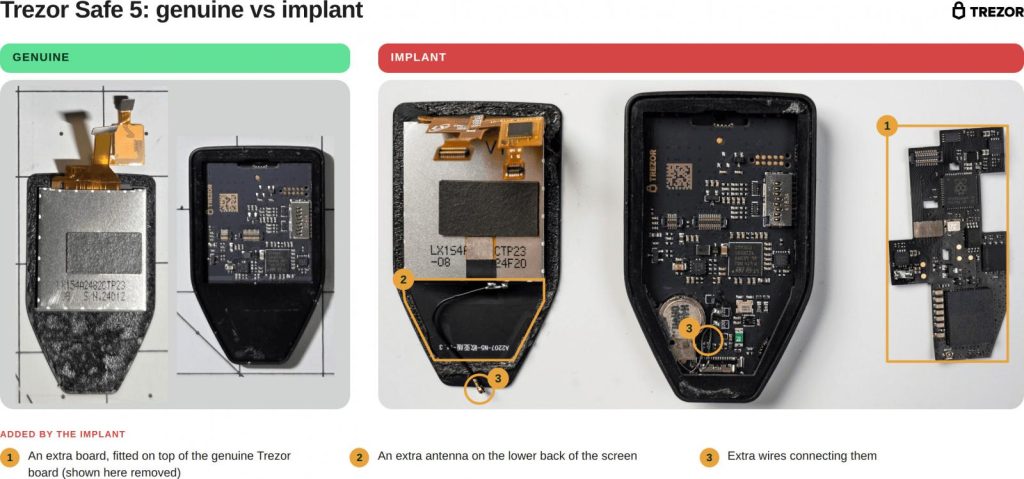
Trezor engineers analyzed the implant’s firmware and confirmed that the hardware can capture sensitive information shown or entered on the wallet’s screen. The implant is an additional circuit board installed between the main board and the display of the Trezor Safe 5. It monitors screen activity without changing the device’s legitimate firmware or Secure Element, the dedicated chip that stores private keys.
When recovery words appear on the screen, either while a new wallet backup is created or when an existing wallet is restored, the implant collects them. It can also capture passphrases shown on the display. The stolen data is encrypted and sent over a mobile network to an attacker-controlled server. If no connection is available, the implant keeps the captured data and repeatedly tries to transmit it until it succeeds.
Trezor noted that these implants follow confirmed hardware implants previously discovered in Ledger devices sold through CryptoBilis, which have been linked to cryptocurrency thefts. The pattern points to a supply-chain attack, in which a device is compromised before it reaches the buyer.
Firmware fix and what it cannot undo
On November 11, Trezor released firmware version 2.13.1, which includes protections that stop the implants from capturing information. Trezor said in a statement: “Our latest firmware update 2.13.1, released on November 11th, includes a protection that stops the implants we’ve found from capturing anything on devices that run it, making the current batch of implants useless.”
The update cannot protect recovery phrases that were already captured before it was installed. For that reason, Trezor advises customers who bought a Trezor device from CryptoBilis to move their cryptocurrency to a newly created wallet using a new recovery phrase. No Trezor customers have reported stolen funds so far.

Reseller network cut by about 80%
Because of these supply-chain attacks, Trezor has reduced its global reseller network by approximately 80%. The company first announced plans to shrink the network in October, after reports of compromised Ledger wallets sold through CryptoBilis. At that point, Trezor had not yet learned that its own devices were affected.
Trezor said the removed resellers were trustworthy and posed no threat, but they did not meet the stricter supply-chain security requirements the company is introducing. Remaining partners must follow tighter controls over how devices are sourced, stored and accessed.
The company is offering replacement devices to anyone who bought a Trezor wallet from CryptoBilis since March 2026, including customers whose devices have not been confirmed as compromised. Trezor said it has found no evidence of implants from other resellers and has received no reports of funds stolen through the compromised Safe 5 wallets.