

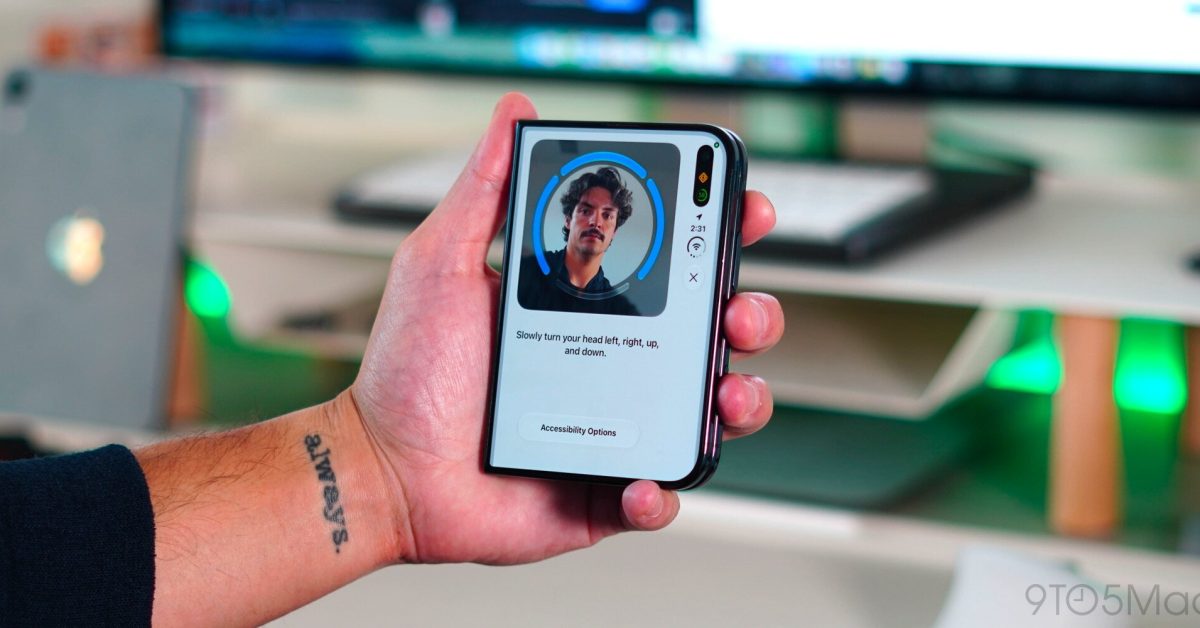
Apple is bringing a camera-only face option to the iPhone Duo, a method it once criticized when rivals used it. The iPhone Duo face option is less secure than Face ID, but Apple has added several limits on when and how it can be used.
When Apple introduced Face ID, the company stressed how secure its system was. It contrasted Face ID with the far less secure image-based facial unlock systems used by Google and Samsung, among others. Now Apple is offering that weaker approach as an option on the iPhone Duo.
How camera-only face recognition developed
The first smartphone with face recognition was the Galaxy Nexus, released in 2011. It required no extra hardware and relied on the front-facing camera, which took a photo and compared it with a stored image of the user. Security researchers found within days that the system could be fooled by holding up a photo of the owner’s face on another device. Samsung was still using this camera-based approach as late as 2019.
Apple took a different route with the iPhone X in 2017. Face ID uses a dedicated hardware module with infrared emitters and receivers to build a 3D map of the shape of a face. Photos and even models cannot fool it. At launch, Apple said the chance of a random person unlocking the phone was less than one in a million, with added caveats for identical twins and similar cases.
Face ID projects more than 30,000 invisible infrared dots onto the face. Neural networks process the infrared image and dot pattern into a mathematical model of the face, which is sent to the Secure Enclave to confirm a match. The system adapts to gradual changes in appearance over time. Saved facial data stays protected inside the Secure Enclave, and all processing happens on the device. Apple has said the probability that a random person could unlock an iPhone or iPad Pro with Face ID is less than 1 in 1,000,000.
Safeguards on the iPhone Duo face option
Apple’s face option is a clear step down in security from Face ID, and the company has built in limits to reduce the risk. Face unlock is disabled by default, so users must turn it on. Each day, the iPhone Duo must first be unlocked with Touch ID or the passcode. The feature also turns off after 45 minutes of inactivity or after a restart.
The feature has one other important restriction. It can only be used to unlock the phone. It cannot be used for Apple Pay, to open password-protected apps or the Passwords app, or for any other action that requires authentication. Users also cannot use it to change their passcode or add a fingerprint to Touch ID.
One feature that has been suggested is geolocation control. A commentator said they would want face unlock to work at home but be switched off when they are out. Currently, users can only disable the feature temporarily by toggling it off or restarting the phone. A proposed option would let people set safe locations, such as home and work, where the feature is disabled in public. Apple has not announced such a setting.
Could the same feature come to the Mac?
Because the method needs only a front-facing camera, a similar option could be added to the Mac with little extra hardware. MacBook users have asked for Face ID for years. Apple has filed patents on the technology for about a decade, but a MacBook version has not arrived. A camera-based option would be a partial answer to that request.
Roman Loyola of Macworld has also suggested bringing face unlock to the Mac. Readers are being asked whether they would enable the feature on an iPhone Duo, and whether they want the same option on a MacBook. Apple has not said whether it plans to bring the feature to the Mac.