

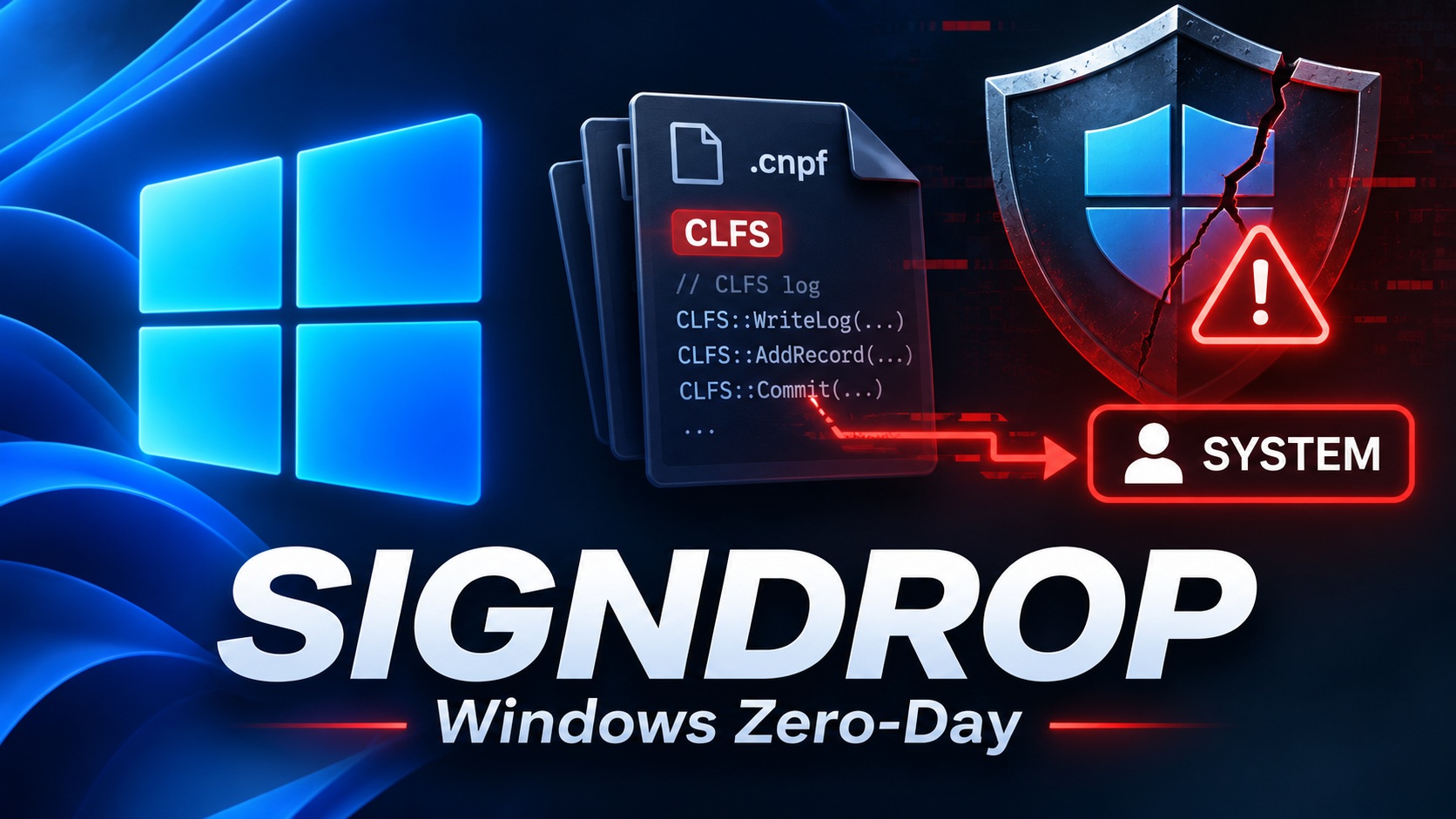
A newly disclosed Windows flaw, dubbed the SignDrop zero-day, could let attackers with standard user privileges gain full SYSTEM access by abusing a security mechanism Microsoft added last year. The affected component was built to stop this kind of privilege escalation, which makes the flaw especially awkward for the company.
How the SignDrop zero-day exploit works
Security researcher Abdelhamid Naceri, who also goes by Nightmare Eclipse or MSNightmare, published a proof-of-concept (PoC) for the SignDrop zero-day on GitHub on November 10, 2026. The exploit targets the Common Log File System (CLFS) driver, which handles logging for Windows applications and system services.
Microsoft introduced CLFS authentication hardening in October 2025 to address long-standing weaknesses in the driver. The mitigation uses cryptographic authentication codes to verify the integrity of log files before the driver processes their contents. Naceri found that the authentication mechanism itself can be manipulated into creating files with elevated privileges.
The flaw centers on how the clfs.sys driver creates accompanying .cnpf authentication files. An attacker first prepares a specially crafted log file, then forces a privileged Windows process, such as Microsoft Defender, to open it. During that interaction, CLFS creates an authentication file using SYSTEM privileges while keeping the access permissions inherited from the attacker-controlled file. Combined with further manipulation, an ordinary user can escalate privileges.
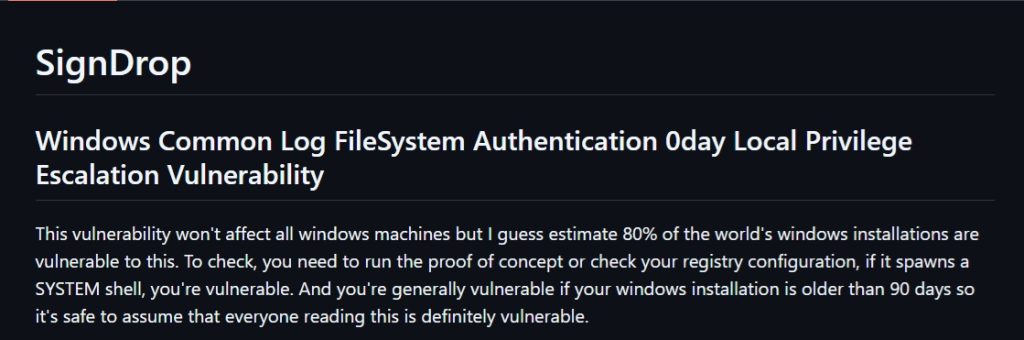
Naceri also claims the technique could bypass antivirus and endpoint detection and response (EDR) tamper protection. The reasoning is that the privileged file operations appear to come from legitimate security processes, so protections that trust those processes may not block them.
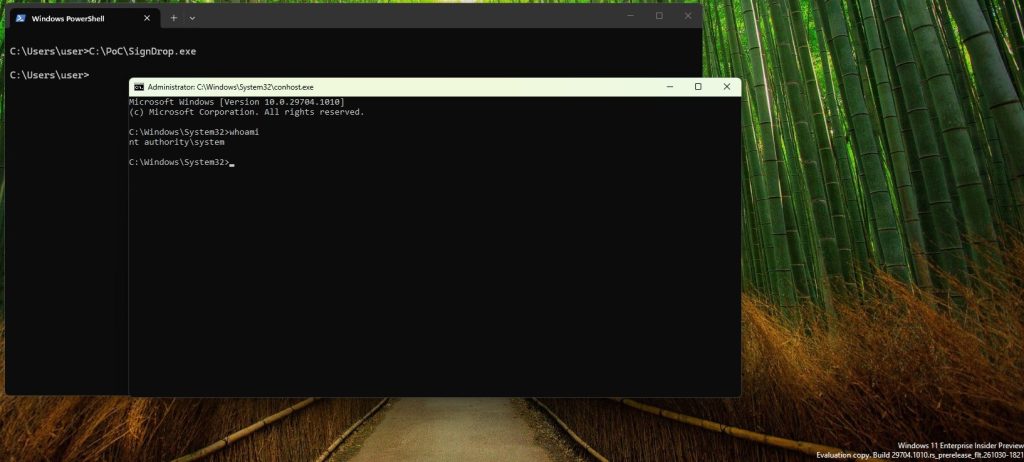
Independent researchers at Cyderes reproduced the exploit and obtained a SYSTEM-level command shell. That result confirms the technique works under certain conditions, although it does not show that it works on every machine.
Which Windows versions are at risk
Naceri tested the SignDrop zero-day against Windows 11 26H2, Windows 11 26H2 Experimental and Windows Server 2025 Experimental. He estimated that roughly 80% of Windows installations could be vulnerable. That figure has not been verified, and independent researchers have reported compatibility and reliability limitations in their testing.
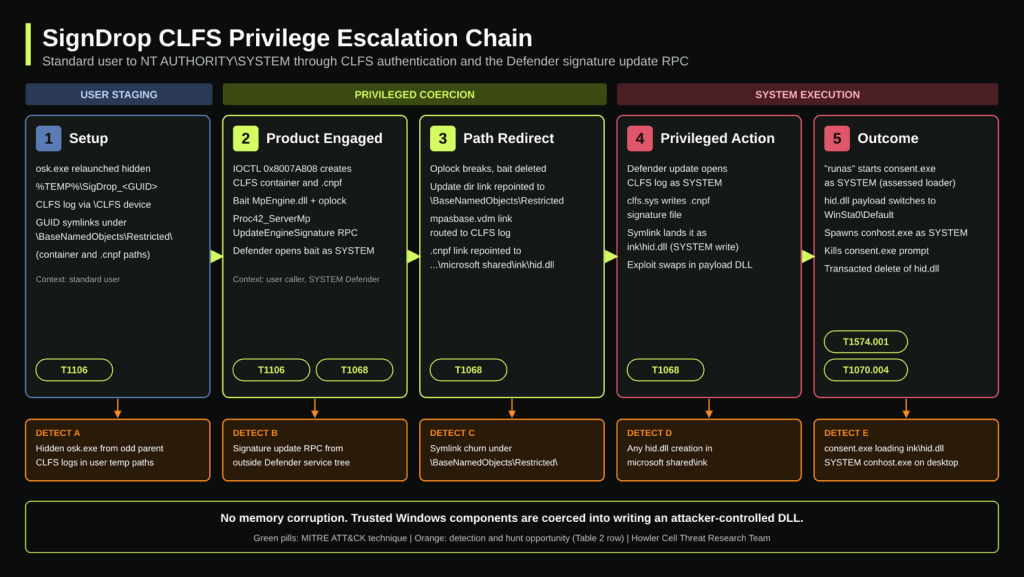
The exploit chain is easier to follow in a visual breakdown. It starts with a standard user staging files, moves through a privileged coercion step involving Defender, redirects a file path, and ends with a privileged write that lets the attacker load a DLL into a trusted Windows component. No memory corruption is required, which is why the chain relies on trusted components instead of a memory bug.
Checking whether your PC has the affected setting
Users can check whether the affected CLFS authentication mechanism is enabled by opening the following Windows Registry location: HKEY_LOCAL_MACHINESYSTEMCurrentControlSetServicesCLFSAuthenticationMode. According to Microsoft’s documentation, a value of 0 (enforcement mode) or 1 (learning mode) indicates an active mitigation and a potentially vulnerable configuration.
A matching value does not guarantee that the exploit will work on a given machine. Naceri’s own project page also says that running the PoC is a direct test, and that a SYSTEM shell means the system is vulnerable. Users who want a certain answer should therefore rely on testing rather than the registry value alone.
What Microsoft has said and what users should do
Microsoft has acknowledged the reports and is investigating the vulnerability. The company told reporters that Microsoft Defender can detect and block exploitation attempts. Microsoft also said it has found no evidence of active exploitation in the wild.
Users should not turn off CLFS authentication as a workaround. Doing so could expose computers to older memory-corruption vulnerabilities that the mitigation was meant to address. Instead, administrators should keep installing Windows and Defender security updates while they wait for further guidance.
At the time of writing, the SignDrop zero-day has no official CVE designation and no dedicated security patch. Whether Microsoft ships a fix in a future update, and how quickly, has not been announced.