

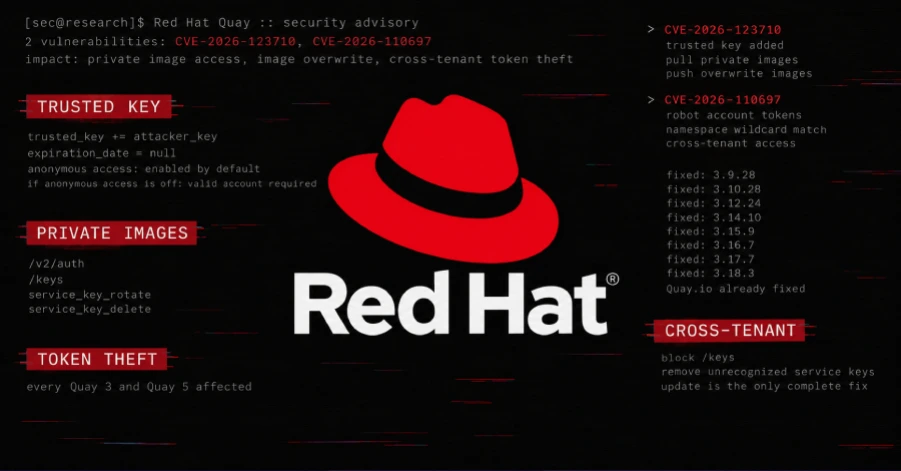
A critical flaw in Red Hat Quay lets an attacker who can reach a Quay registry read and overwrite private container images in every repository. Red Hat has released fixed builds for eight Quay 3 branches.
Quay enables anonymous access by default. While that setting is on, an attacker needs no account to exploit the flaw. When anonymous access is turned off, anyone with a valid account can still use it, Red Hat said.
CVE-2026-123710 and the planted signing key
The flaw, tracked as CVE-2026-123710, carries a CVSS score of 9.8. Quay uses a set of trusted keys to sign the access tokens that allow images to be pushed and pulled. The flaw lets an attacker add their own key to that trusted list with no expiry date. Quay then accepts tokens signed with the attacker’s key for any repository on the registry.
With those tokens, an attacker can retrieve private images along with any secrets or credentials stored inside them. The attacker can also push new images or overwrite existing ones. Any change propagates to every system that later pulls those images, which can spread a tampered image well beyond the original registry.
The planted key survives restarts until an administrator removes it. An attacker can also use it to delete the keys that running Quay instances rely on. When those keys are gone, normal pushes and pulls begin failing with authentication errors.
Why the key server check does not hold
Quay’s key server checks that any request to replace a key carries a token signed by a trusted key, with the expected audience and issuer. It does not check whether that token was issued for key rotation. An anonymous token from the Quay /v2/auth endpoint passes this check. Quay signs that token with a trusted key, and the caller chooses the audience, so the anonymous token is enough to register a new key.
CVE-2026-110697 and cross-tenant robot tokens
A second critical flaw, CVE-2026-110697, was disclosed at the same time and carries a CVSS score of 9.9. It lets a Quay user who can create a namespace steal robot account tokens belonging to other tenants. The stolen tokens can then be used to read, push, or overwrite those tenants’ images.
The bug sits in the code that lists robot accounts. That code builds an SQL LIKE pattern from the namespace name without escaping wildcard characters. In SQL LIKE, an underscore matches any single character, so a namespace with an underscore in the right place can match another tenant’s namespace and return its robot accounts, along with their decrypted tokens. The attacker needs no elevated privileges, and the victim does not have to take any action.
Deleting the attacker’s namespace also deletes the matching robot accounts, which can cut off systems that depend on them. Where Quay serves as the integrated registry for Red Hat OpenShift, stolen robot credentials can be used to inject malicious images into CI/CD pipelines, the company said.
Red Hat’s Dave O’Connor found both flaws. According to the bug report for CVE-2026-123710, the logic behind that flaw has been in Quay since its first public commit.
Affected versions and recommended steps
Red Hat lists every version of Quay 3 and Quay 5 as affected by both flaws. For CVE-2026-123710, the guidance names standalone installs, Quay deployed through the Quay Operator on OpenShift, and the mirror registry for Red Hat OpenShift. Red Hat says any Quay instance that untrusted clients can reach is exposed, including internal registries.
When checked, the CVE entry for CVE-2026-123710 still showed every Quay package as affected with no fix, even though each advisory lists the flaw. The company recommends the following steps:
- At the proxy or load balancer, block the /keys endpoint for everything except trusted internal components.
- Search the audit logs for service_key_rotate and service_key_delete events where expiration_date is null.
- Remove any approved service keys that are not recognized.
- Install the fixed release. Until it is running, an attacker can add a new key the same way, so deleting one key does not last.
Red Hat also warned that turning off anonymous access is not enough. “Turning off anonymous access doesn’t protect you,” the company said in its key remediation article. A planted key continues to work after password resets and changes to the robot token.
For CVE-2026-110697, the company’s CVE page names the same eight releases as fixed and calls updating the only complete fix. The page also says Quay.io is already fixed. None of the eight advisories, however, list CVE-2026-110697.
Until an update is installed, Red Hat suggests limiting who can create organizations or namespaces that contain an underscore. It also recommends rotating robot tokens for any namespace that matches an underscore namespace and watching for pulls or pushes that do not fit normal robot use. These steps reduce exposure, but the flaw itself remains. The upstream fix adds the missing rotation check, requires keys added through the key server to have an expiry date, and stops callers from choosing a token’s audience. The same change also fixes the robot account search.