

A lesser-known open-source project called LiberNT is trying to bring modern Windows compatibility to an operating system that contains no Microsoft code. The LiberNT Windows project is highly experimental, but it aims to run current Windows applications and drivers without relying on Microsoft’s proprietary software.
Most people who want a Windows 11 alternative turn to Linux distributions. LiberNT takes a different route. Instead of building on the Linux kernel, it aims to recreate the Windows NT architecture itself. The project was founded by developer Ahmed Arif and is available for free through its official GitHub repository, with Windows 11 24H2 as its primary compatibility target.
How LiberNT Windows builds on ReactOS
LiberNT is based on ReactOS, a long-running open-source project that tries to reproduce Windows functionality independently. ReactOS has historically targeted much older Windows versions. LiberNT Windows is aiming considerably higher, with the goal of supporting modern Windows releases.

Architecture changes and supported platforms
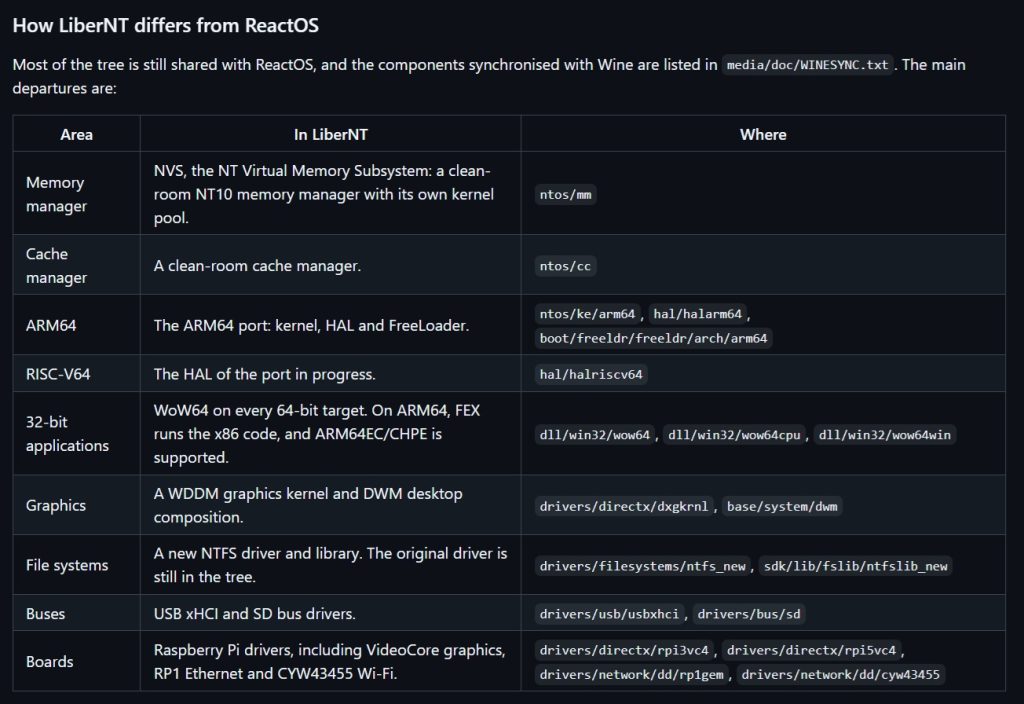
According to the project’s official development documentation, the developers have made substantial architectural changes. These include a new NT-compatible virtual memory subsystem, called NVS, with its own kernel pool, a replacement cache manager, an updated NTFS driver and library, and work on modern graphics drivers and desktop composition through a WDDM graphics kernel and DWM.
The operating system targets AMD64, ARM64 and RISC-V64 processors. It also includes support for modern hardware interfaces such as PCIe, NVMe storage and USB 3.0. Optional features include WoW64 support for 32-bit applications and FEX-based x86 emulation on ARM64 hardware. The documentation lists USB xHCI and SD bus drivers, along with drivers for Raspberry Pi boards, as part of the tree.
Experimental Linux application support
LiberNT Windows has also added experimental support for running Linux applications without a Linux kernel or a dedicated virtual machine. Independent testing by IT-Connect showed that the operating system includes a Linux terminal capable of launching Ubuntu programs.
Some graphical Linux applications can run in individual desktop windows. Hardware-accelerated graphics and audio are not supported in that environment yet, which limits what these programs can do.
What the Windows 11 look-alike desktop offers
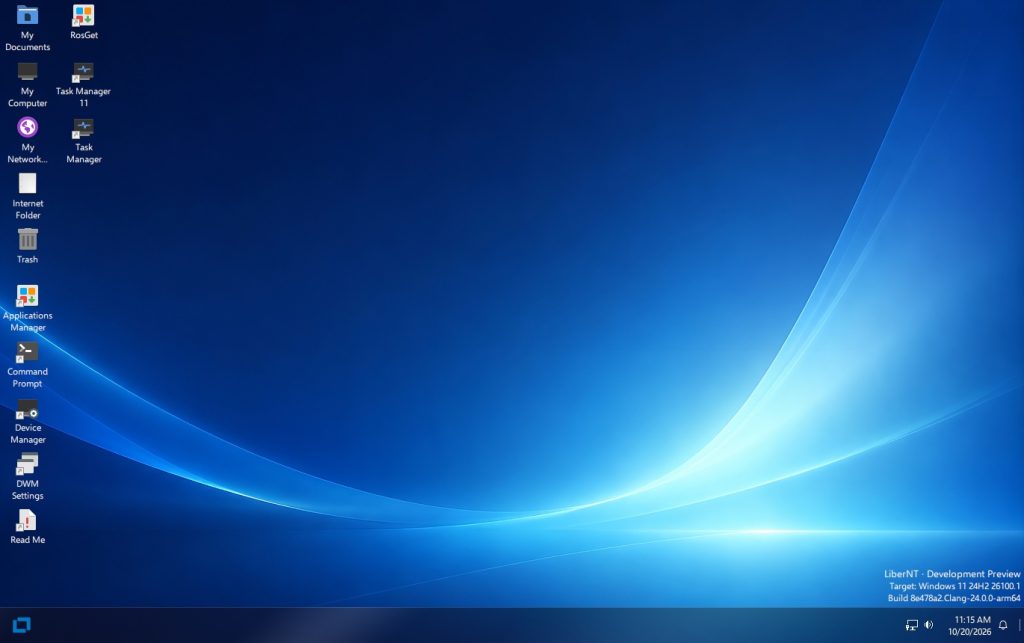
The desktop closely resembles Windows 11. It includes a familiar taskbar, File Explorer with tabs, context menus and a Settings application. The initial setup wizard offers downloads for popular applications, including Google Chrome, Firefox and Steam. The project notes that these offers should not be mistaken for guaranteed compatibility.
The developers also say they use AI-assisted coding and code reviews. They state that generated changes go through human review and testing. Their Windows compatibility work is described as a “clean-room implementation” based on Microsoft’s public documentation, development headers and behavioral comparisons.
Early builds are far from replacing Windows 11
Despite its ambitious goals, LiberNT Windows is not ready to replace Windows 11 on everyday PCs. The publicly available builds are primarily debugging pre-releases. They have incomplete application compatibility, limited driver support and potential stability problems. Testing in certain virtualized environments also requires disabling Secure Boot.
The developers explicitly recommend running LiberNT inside a virtual machine or on spare hardware, not on a primary computer. For users, that means the project is a testing platform rather than a practical daily driver.
LiberNT differs from Valve’s Proton, which lets Windows games run on Linux. Proton translates Windows calls on top of an existing Linux system, while LiberNT is trying to build an independent Windows-compatible operating system from the ground up. Whether it can deliver broad software, driver and gaming compatibility is still an open question, and the project’s progress will determine how far that goal is reached.