


Voters pushed back hard on data center restrictions in the November 3 midterm elections, approving limits on development in 40 of 41 local ballot measures. The results add political pressure to the AI industry’s plans to expand its infrastructure at a rapid pace, especially as power demand and hardware needs keep climbing.
How the data center restrictions vote played out
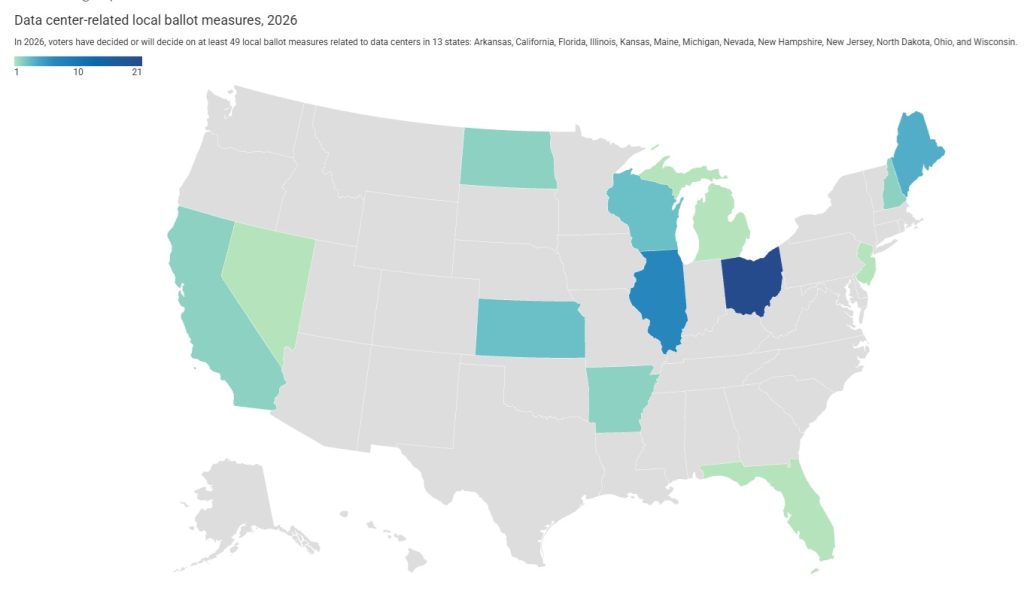
According to Ballotpedia’s November 6 analysis, voters across ten U.S. states approved 27 measures that restricted data center development or expressed opposition to it. Voters rejected another 13 measures that would have facilitated or supported construction. The only exception was Harwood, North Dakota, where residents turned down additional review requirements for certain industrial projects, including data centers.
Ohio was the center of the action. The state accounted for 21 of the 41 measures, more than any other state. Local voting on data center restrictions was not confined to one region, and the measures reached communities across the country.
From outright bans to advisory votes
The restrictions differed widely in scope. Five measures introduced outright bans on data centers, and twelve imposed partial bans. Three established six-month moratoriums that would pause projects while local governments weigh their options. Other measures dealt with zoning rules, required voter approval before certain projects could move forward, set financial guarantees, or simply voiced nonbinding opposition.
That range matters for how far the votes can reach. Many of the measures were narrowly targeted or advisory, so they do not amount to a nationwide ban on data centers. Still, data center restrictions that pass at the local level can slow or redirect individual projects, and developers must account for them when choosing sites.
Electricity, water and utility bills fuel the backlash
The results reflect growing public concern about the large amounts of electricity and water that large-scale data centers require. Residents have also raised questions about possible increases in household utility bills and the environmental effects of new facilities.
The International Energy Agency highlighted those same challenges in its October 2026 report. The agency identified electricity affordability, energy security and sustainability as major considerations for continued AI infrastructure expansion. Those concerns now show up directly in local ballot boxes, where voters are deciding whether they want new facilities in their own communities.
What the vote could mean for AI spending and chipmakers
The implications for the technology industry could be significant. Microsoft, Amazon, Google, Meta and Oracle are collectively investing large sums in AI infrastructure. Chipmakers such as Nvidia and AMD benefit from the demand for accelerators that power these facilities.
Altimeter Capital’s Brad Gerstner has suggested that political opposition could delay between 10 and 15 gigawatts of planned data center capacity in 2027. That figure is an estimate, not a confirmed reduction in construction. Financial markets have already reacted, and Reuters reported that AI infrastructure companies faced renewed selling pressure after the elections.

Memory prices could be the consumer angle
A slowdown in AI infrastructure spending could eventually help consumers, particularly PC gamers who have dealt with persistently high memory prices. In an interview with Wccftech, Micron acknowledged that extraordinary data center demand has contributed to industry-wide DRAM shortages. The company said meaningful new manufacturing capacity is not expected until 2028.
If AI infrastructure demand moderates substantially, pressure on the memory supply chain could ease over time. Existing supply commitments, manufacturing lead times and continued AI demand mean that cheaper DDR5 memory or graphics cards are far from guaranteed. Buyers should not expect quick relief even if data center restrictions spread.

For now, the elections do not amount to a nationwide ban, and the measures vary widely in how much they restrict construction. What remains uncertain is whether the local votes will be followed by similar measures in other states, and how much of the planned 2027 capacity will actually be delayed.