

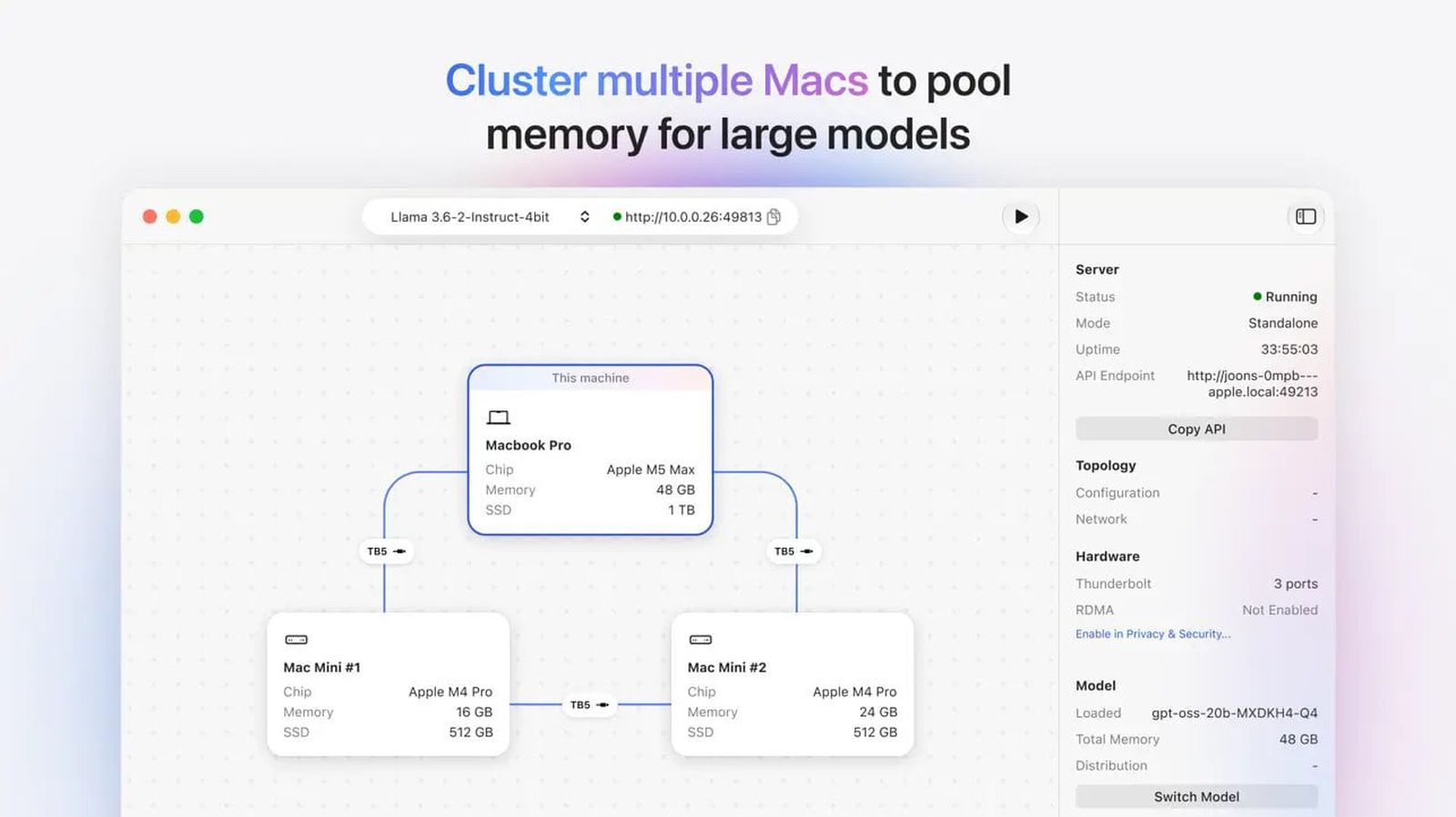
Apple’s Claris subsidiary is testing a new app called Harbor, which turns Apple silicon Macs into a private AI inference server. The Claris Harbor app runs open-weight models on the user’s own hardware and can combine several Macs into a single cluster for larger workloads.
How Harbor runs AI models on a Mac
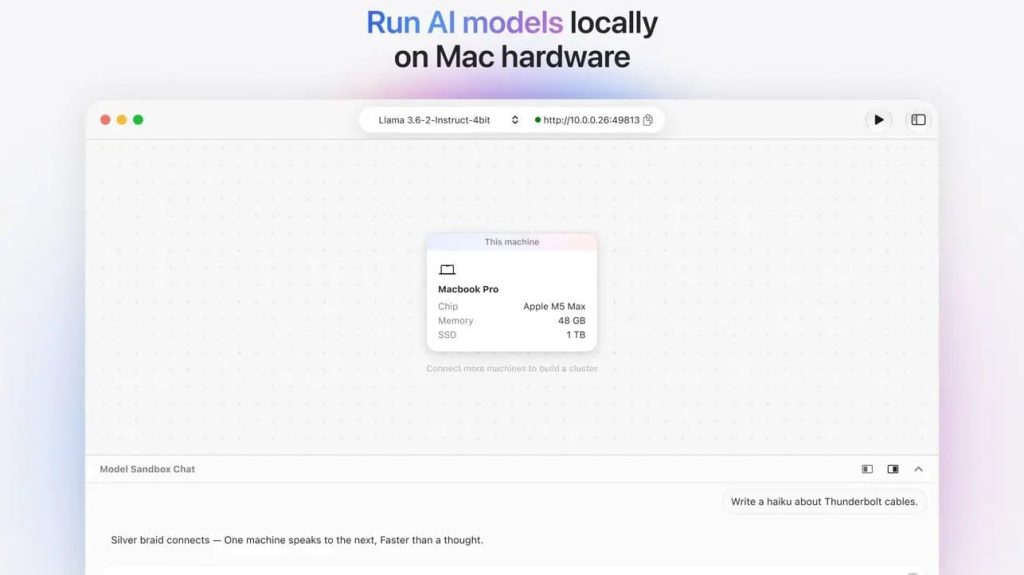
Harbor works with a single Apple silicon Mac. Users can browse, download and load open-weight models from inside the app, and Harbor handles model management in the background. According to Claris, data stays on the local machine and does not reach the cloud, so prompts and outputs are never sent to an outside server.
The app is described as easy to use. Apple says no manual configuration is needed, and users do not have to work from the command line or have infrastructure experience to get a model running. Claris says setup takes minutes rather than hours.
Clustering Macs over Thunderbolt 5
The more significant feature is clustering. Harbor supports connecting multiple Mac computers over Thunderbolt 5 to pool their unified memory. Unified memory is the shared pool of RAM that Apple silicon chips use for both the CPU and GPU, and pooling it across machines lets a cluster load models that would not fit in any one computer.
Harbor detects compatible devices automatically once they are connected over Thunderbolt 5 and forms a cluster without further setup. Claris says a cluster can run models larger than any single machine’s capacity, or handle more concurrent requests at the same time. Two or more Thunderbolt 5-capable Macs are needed to build a cluster.
Apple added RDMA over Thunderbolt 5 with macOS Tahoe 26.2, which makes clustering faster by letting machines move data directly between their memories. That update is the foundation Harbor relies on for pooling memory across Macs.
Early access and the App Store listing
Harbor is in early access and is not publicly available. An App Store listing existed for the app, but it has since been removed. The sign-up page asks for a company name, which points to a business audience rather than general consumers.
That focus fits Claris’s background. The subsidiary is best known for FileMaker, a database platform aimed at businesses. Claris has not said how Apple plans to market Harbor or whether it will be free.
How Harbor compares with existing Mac tools
Mac users who want a local AI server already have free options. Exo is an open-source tool for clustering Macs together. LM Studio is available for running models on a single Mac and is known for a simple interface. Apple’s Harbor appears to combine LM Studio’s style of interface with the multi-Mac clustering that Exo provides.
Running models locally has become a common goal for developers and small teams that want to keep data on their own hardware. Harbor’s pitch rests on that idea, along with the use of Thunderbolt 5 links between machines instead of a separate networking setup.
What remains unclear
Several details have not been confirmed. Apple has not announced a release date, pricing or a full list of supported models. It is also not clear whether Harbor will stay a standalone app or become part of a wider Apple product, or whether it will be offered at no cost. For now, Harbor’s availability is limited to testers in early access, and any broader launch would need to come through Apple or Claris.