

Microsoft Advertising is rolling out what it calls its biggest bidding model upgrade in a decade. The new models use more signals to predict whether an ad click will turn into a conversion and what that conversion might be worth.
Microsoft will apply the upgrade automatically as it reaches more accounts. That means campaigns can start spending differently before advertisers make any changes themselves. Microsoft announced the rollout on November 18 and plans more bidding updates in 2027.
What the Microsoft Advertising upgrade changes in live campaigns
Microsoft says the new models can change how quickly campaigns spend and how closely they stick to their targets. Three areas are likely to show the effects first.
- Budget pacing: Campaigns can ramp up to their full budgets sooner and spend more evenly through the day.
- Target changes: When advertisers raise or lower a CPA or ROAS target, bids can adjust nearly twice as fast.
- Performance against targets: Microsoft says campaigns can hit those targets more consistently without giving up conversion volume or value.
A target is a ceiling, not a fixed price. A $50 CPA target still leaves room for a campaign to bring in conversions at $40 each, even when it spends its full budget. A maximum CPC bid can limit that flexibility. If an advertiser averages $3 a click and caps bids at $5, the cap rules out a $6 bid, even if the system expects that click could lead to a conversion within the CPA target.
Timing is another factor. Say an advertiser raises its CPA target on Monday, and customers usually take a week to buy. By Friday, the advertiser knows what Monday’s clicks cost, but some sales may still be pending. Faster bidding does not shorten the time customers take to make a purchase.
Raising a CPA target or lowering a ROAS target can open up auctions that a campaign previously passed up. To limit swings in performance, Microsoft suggests making those changes in 15% increments and reviewing each one after a single conversion cycle. For bigger changes, such as switching bid strategies or adding a conversion goal, Microsoft recommends allowing one to two cycles.
How much conversion history a new campaign needs
Microsoft recommends conversion-based bidding for new campaigns once an account has at least five conversions. Those conversions can come from campaigns the advertiser already runs. If an account is still gathering its first five, Enhanced CPC is an option.
Microsoft Advertising Liaison Navah Hopkins addressed whether the same advice applies to low-volume accounts that already use Enhanced CPC. She said every account is different, so a blanket recommendation still needs testing. As long as an account has at least five conversions in total, the system can use them to begin conversion-based bidding. She still recommended a 30-day evaluation period and few changes for accounts with fewer conversions.
For judging performance, Microsoft recommends around 30 conversions in 30 days at the campaign or portfolio level. A low-volume campaign can reach the end of its first month and still have too few conversions to judge whether the switch worked.
What Microsoft’s internal data shows about the upgrade
Microsoft reported 10% more conversion value per click at roughly the same ROAS after the model upgrade. That result came from August 2026 global Search and Audience Network data for advertisers using Maximize Conversion Value or Target ROAS.
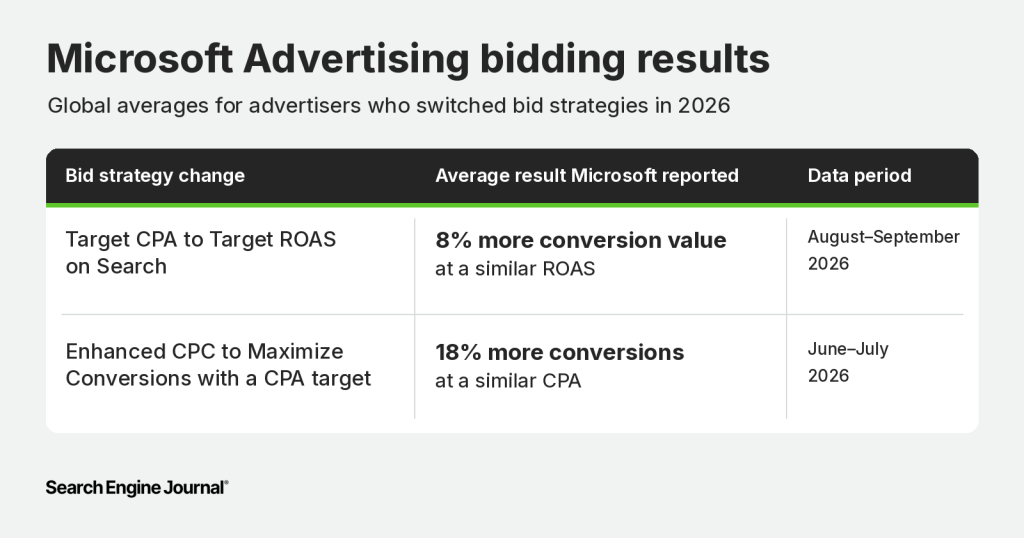
Microsoft also examined advertisers who switched bid strategies. Search advertisers who moved from Target CPA to Target ROAS saw 8% more conversion value at a similar ROAS. Advertisers who moved from Enhanced CPC to Maximize Conversions with a CPA target saw 18% more conversions at a similar CPA.
What advertisers should check before setting new targets
Advertisers considering Target ROAS can pull up a few recent purchases in Microsoft Advertising and compare the reported values with the actual order totals. A $40 order and a $400 order can both register as conversions, even when tracking assigns them the same value. That gap is easy to miss if an advertiser only checks that purchases are coming through.
Microsoft reported its largest gains from value-based bidding among advertisers who sent actual transaction values. If a purchase goal uses a fixed value, the reported ROAS reflects that estimate. The figure can move as an advertiser sells more or spends less, but it will not capture changes in how much customers spend per order.
Lead generation brings a different challenge. Two people can submit the same form, and sales may learn a week later that only one is a good fit. Pedro Bailaderia asked Hopkins whether advertisers should send an estimated value at submission and update it once more information reaches the CRM. Hopkins supported that approach through the Conversions API or offline imports, and she advised setting a ROAS target that reflects the values being sent.
If a sales team has not settled on how to value a qualified lead, that work should come before a ROAS target is set. Otherwise, a campaign can hit its target while sales is still waiting for leads it can work with.
For campaigns that already deliver the sales or leads an advertiser needs at an acceptable cost, Microsoft’s guidance points toward patience. Keeping settings steady makes it easier to see how the new models perform against existing goals and budgets. Microsoft has not said when the upgrade will reach every account, and more bidding updates are planned for 2027.