

Google has launched Gemini 4 Hydrogen, a flash-class model built for speed and low cost, days after introducing the Gemini 4 Argon and Gemini 4 Carbon models. The new Gemini 4 Hydrogen is aimed at everyday tasks, coding and agentic workflows, and Google says it is the fastest model in its lineup to date.
Where Gemini 4 Hydrogen is available
Google is rolling out Gemini 4 Hydrogen to all tiers of Google AI Studio, the Gemini API, Gemini for business, the Gemini app and Google Search. Paid Google AI Pro and Ultra subscribers can also use the model in Google Antigravity.
Google chief executive Sundar Pichai described the model as “built for speed and efficiency for everyday tasks, coding and agentic workflows.” He said Gemini 4 Hydrogen finishes tasks 2.5x faster than Gemini 3.8 Flash. The model also offers four thinking levels, so users only wait for and pay for the amount of reasoning a task needs.
Benchmark results against Claude and GPT rivals
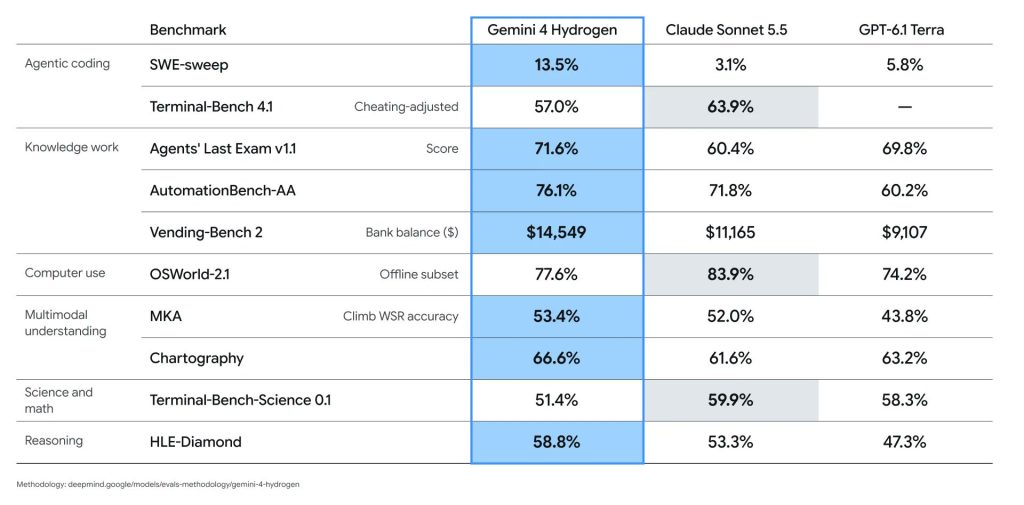
Google’s own benchmark tables show Gemini 4 Hydrogen leading Anthropic’s Claude Sonnet 5.5 and OpenAI’s GPT-6.1 Terra in nearly every category. The tests cover agentic coding, knowledge work, computer use, multimodal understanding, science and math, and reasoning.
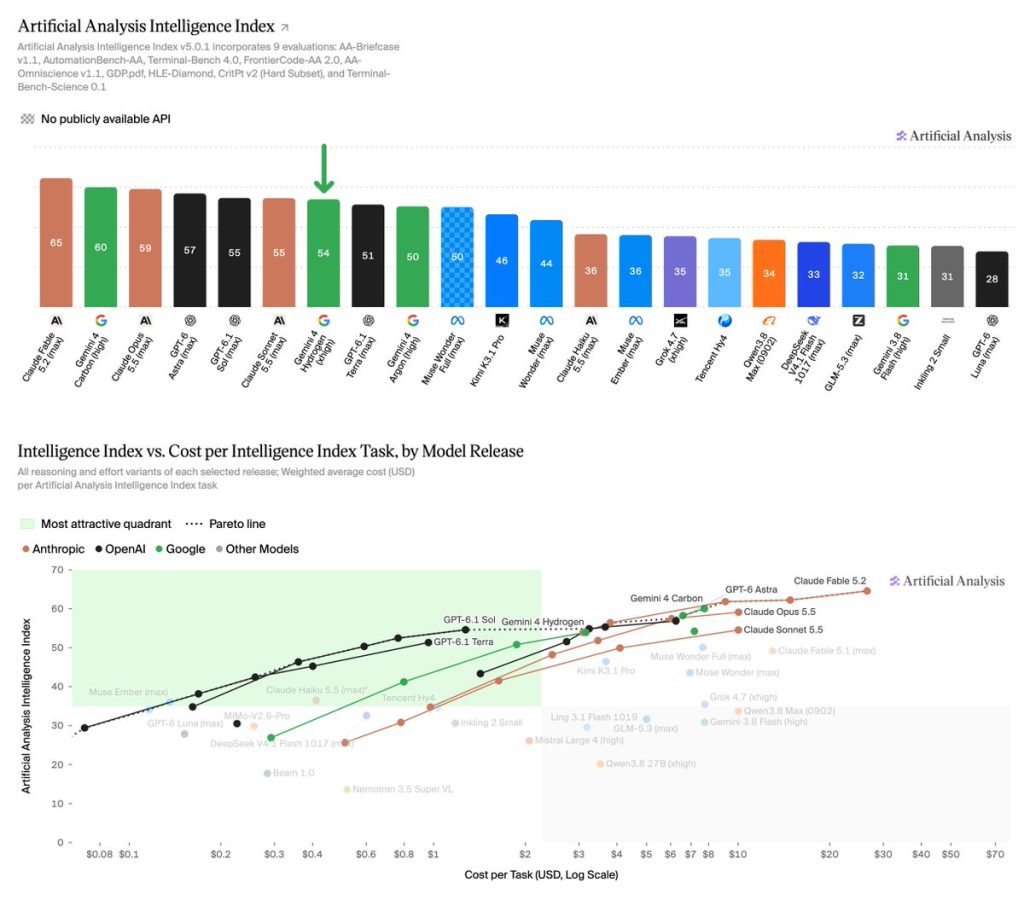
Artificial Analysis, an independent benchmarking firm, scored Gemini 4 Hydrogen at 54 on its Intelligence Index at the xhigh reasoning level. That places the model one point below Claude Sonnet 5.5 (max) and GPT-6.1 Sol (max), and four points ahead of Gemini 4 Argon (high). Artificial Analysis also said the model is ranked among the leading systems on its index, which rates models across several evaluations.
Pricing and cost per task
Google priced Gemini 4 Hydrogen at $1.50 per 1 million input tokens and $7.50 per 1 million output tokens. Tokens are the units that AI models read and generate, so these rates determine what developers pay for API usage.
Cost per task depends on how much reasoning a model uses to finish a job. At the xhigh reasoning level, Artificial Analysis found that Gemini 4 Hydrogen costs about 32 percent as much as Claude Sonnet 5.5 (max) on a given task, for nearly equal intelligence. Against GPT-6.1 Sol (max), the same comparison shows Gemini 4 Hydrogen costing about 2.5 times as much on that task.
Output speed and Vals Index ranking
Gemini 4 Hydrogen delivers an output speed of around 200 tokens per second, which Google positions as a key advantage for agent tools that chain many steps together. Faster output means shorter waits for answers and code.
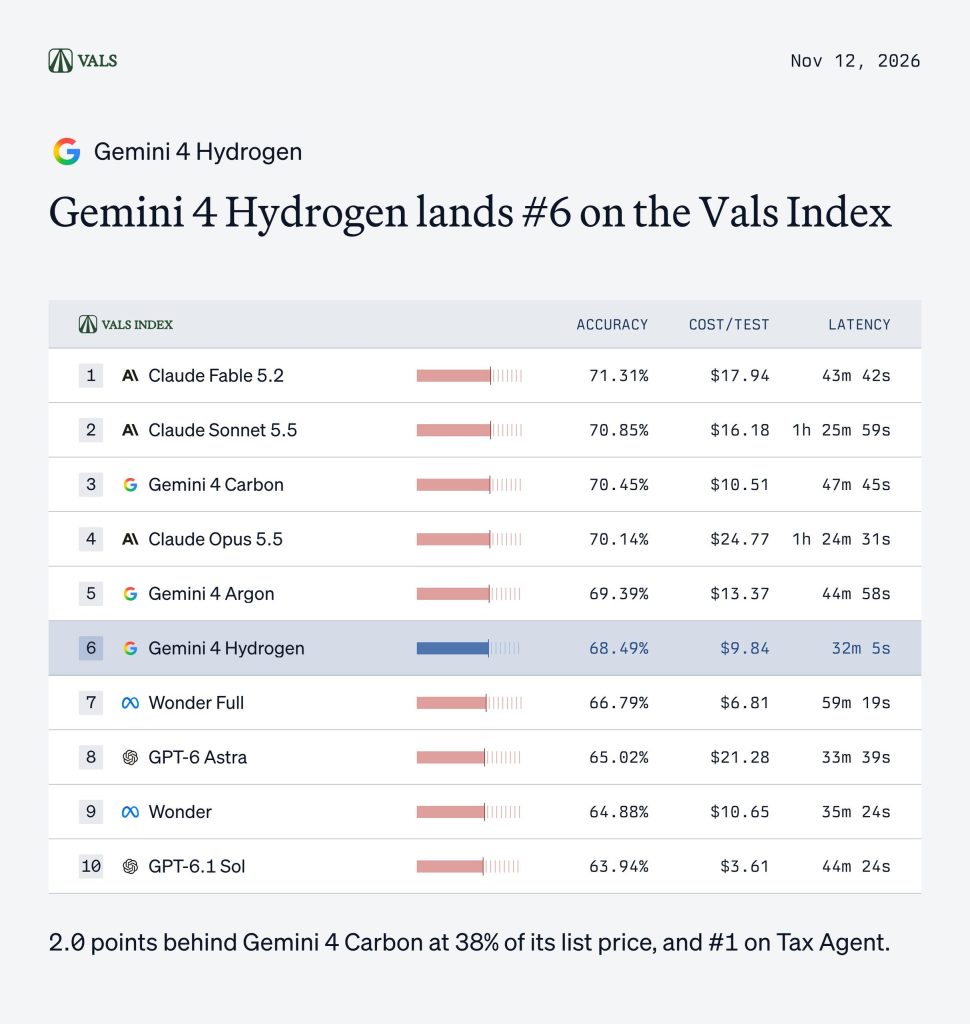
Vals AI placed Gemini 4 Hydrogen sixth on its Vals Index, with 68.49% accuracy, a cost of $9.84 per test and a latency of 32 minutes and 5 seconds. Vals AI said the model is “the cheapest and fastest model in the top 6” ranking. The top six now consists entirely of models from Anthropic and Google, while OpenAI’s GPT-6 Astra sits in eighth place. Vals AI also noted that Gemini 4 Hydrogen is 2.0 points behind Gemini 4 Carbon, which costs 38 percent of its list price, and ranks first on its Tax Agent test.
What the launch means for developers and users
For developers, the main draw of Gemini 4 Hydrogen is the combination of speed, a configurable reasoning depth and a lower price than some top-ranked rivals. Teams building coding assistants or multi-step agents can choose the thinking level for each task instead of paying for maximum reasoning on every request.
Google’s rapid release pace also means the Gemini 4 family now includes Carbon, Argon and Hydrogen. Benchmark leadership in this market changes quickly, and the Vals Index and Artificial Analysis rankings already show Anthropic and OpenAI models at the top of several charts. Users who want to compare the models directly can test them in Google AI Studio or through the Gemini API.