


Security researchers Shubham Shah and Sam Curry found that the ForgeRock login system behind two car brands’ mobile apps could be taken over completely. The access would let them reach any customer’s account and, for owners with connected cars, unlock the doors and start the engine. They published their work late last week.
How the ForgeRock login setup was exposed
Both apps signed customers in through a ForgeRock login service. ForgeRock is an identity platform that is now part of Ping Identity. The service runs in two parts: one for sign-in and one, called OpenIDM, that holds customer records. On those servers, the researchers reached an administrator console that still used its default password.
A default admin password on the console
OpenIDM includes a built-in administrator console powered by the Apache Felix tool. ForgeRock’s hardening guide tells operators to remove that console or protect it before going live, because it stores its own password separately from the rest of the system. On these servers the console was still present, and it still used the documented default: admin for both the username and the password.
The console was blocked from the open internet, but the edge layer guarding the site and the Java software behind it read the same web address differently. By adding encoded slashes and extra characters, the researchers made the edge treat the request as a harmless static file. The server treated it as the path to the console, and the default password did the rest. The full method is described in the researchers’ technical analysis.
From admin console to customer records and vehicle commands
Inside the console, the researchers used a built-in scheduler to run small scripts. Those scripts executed their own code on the identity server, which gave them a command prompt on the machine that holds customer records for both brands’ logins. The records sat behind the same block as the console, but code running inside the server could reach them.
The researchers changed a target account’s email address and password, then signed in as that customer through the normal app. The sign-in returned the same access tokens the real app uses, and those tokens were the keys to the car. Using the account’s own vehicle commands, they unlocked the doors and started the engine of a test car while the owner stood next to it. They then stopped the engine and locked the car again.
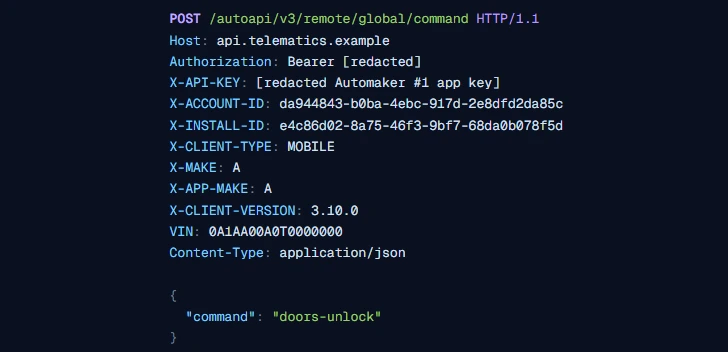
Limits of the tests and the Australian systems
The researchers said they ran vehicle commands only on cars they owned or were permitted to use. They wrote that they “tested the complete chain only with US accounts and vehicles.” They reported being able to open a session for any customer account on the affected ForgeRock login servers.
Shah published a second attack on the Australian systems behind the same brands. The entry point there was different. Admin credentials for the identity server had been left in the app’s code, intended for a test setup. Combined with the first attack, the researchers said they could send unlock and engine-start commands to the brands’ cars in Australia, the United States and Canada. The Australian write-up does not say when those systems were fixed.
What owners could and could not see
The attack left few signs for an owner to notice. Changing the email address and password did not log the owner out of the app. The researchers could also direct the account’s alerts to their own phone, which kept them away from the owner’s device. After the test, they put the real email address back.
Both systems were fixed about two hours after the researchers reported the problem. Neither write-up says whether anyone else found or used the path before it was closed.
Guidance for ForgeRock login deployments
The brands’ mistake was in how they deployed the ForgeRock login platform, not a new bug in the product. As a result there is no CVE, the public identifier that tracks a flaw, and no vendor advisory to follow. The console and its default password have been documented for years, and the production hardening guide already tells operators to remove the console or change its password before launch.
For teams running the same software, now sold as PingIDM, two checks matter. First, look for the Apache Felix console at /system/console, then remove it or change its default password. Second, do not rely on edge or WAF path rules to hide an admin page. A path that the edge and the server interpret differently can slip past those rules, as it did here.
Shah and Curry have a long record of this kind of work, usually targeting the web systems behind apps rather than the vehicles themselves. Their earlier research showed remote access to vehicles from Honda, Kia and Subaru, among others. A Subaru flaw they reported exposed owners’ accounts and cars through that carmaker’s connected-car service. A broader 16-brand study in 2023 found the same kind of web weakness across much of the industry.