


OpenAI says more than 100,000 advertisers have run ads on ChatGPT, and that its ad business reached a $1 billion annualized revenue run rate less than 200 days after launch. Early advertiser results are far less uniform. Some brands report returns that match or beat Google Ads, while others are struggling to earn back what they spent.
What early ChatGPT Ads tests have shown
A recent Business Insider report cited findings from Adthena, which tracked 30 enterprise brands that shared results between July and September. According to Adthena, 52% of those brands struggled to recover their spending, 26% matched or beat Google Ads, and 22% saw mixed results. Adthena did not say how each brand measured returns or which Google campaigns it used for comparison. A brand comparing lead costs could reach a very different conclusion from one comparing closed sales, and a sample of 30 brands offers limited guidance for any single account.
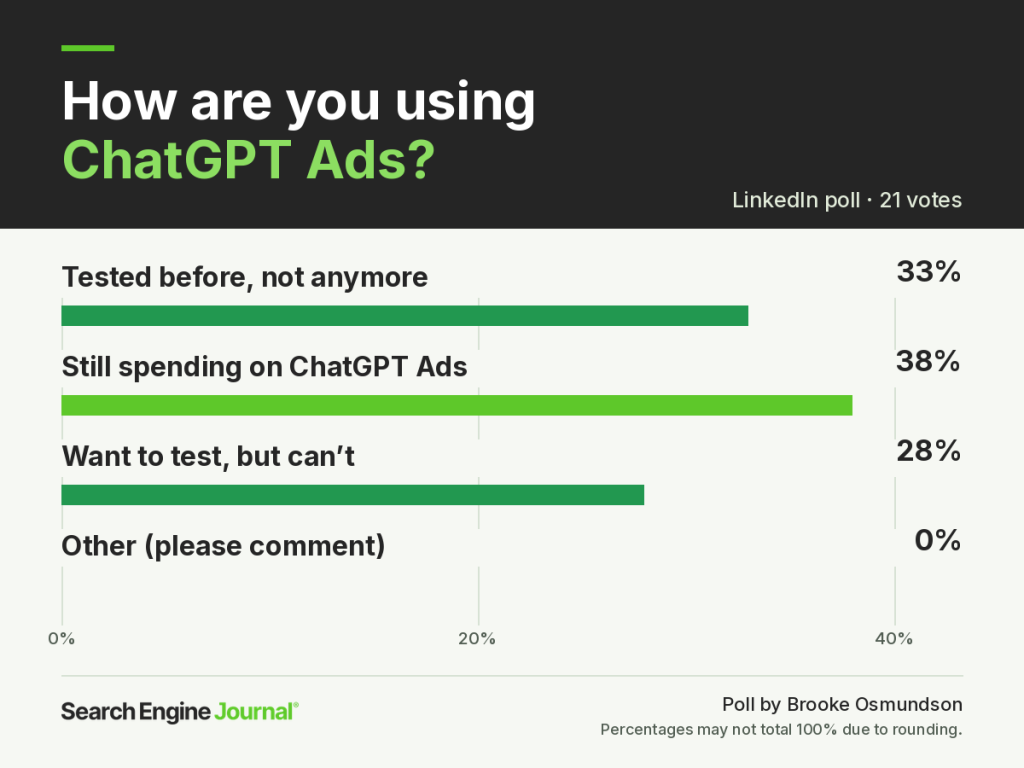
A separate LinkedIn poll asked marketers how they were using ChatGPT Ads. Of 21 respondents, eight were still spending, seven had tested and stopped, and six wanted to test but could not.
Comments on the same poll described problems once campaigns went live. Melissa Mackey described the inquiries from her test as “junk leads.” Trevor Stolber tested the platform to prepare for client work and was “very underwhelmed.” Leah Garcia said creative drift was her main challenge at a moderate spend level.
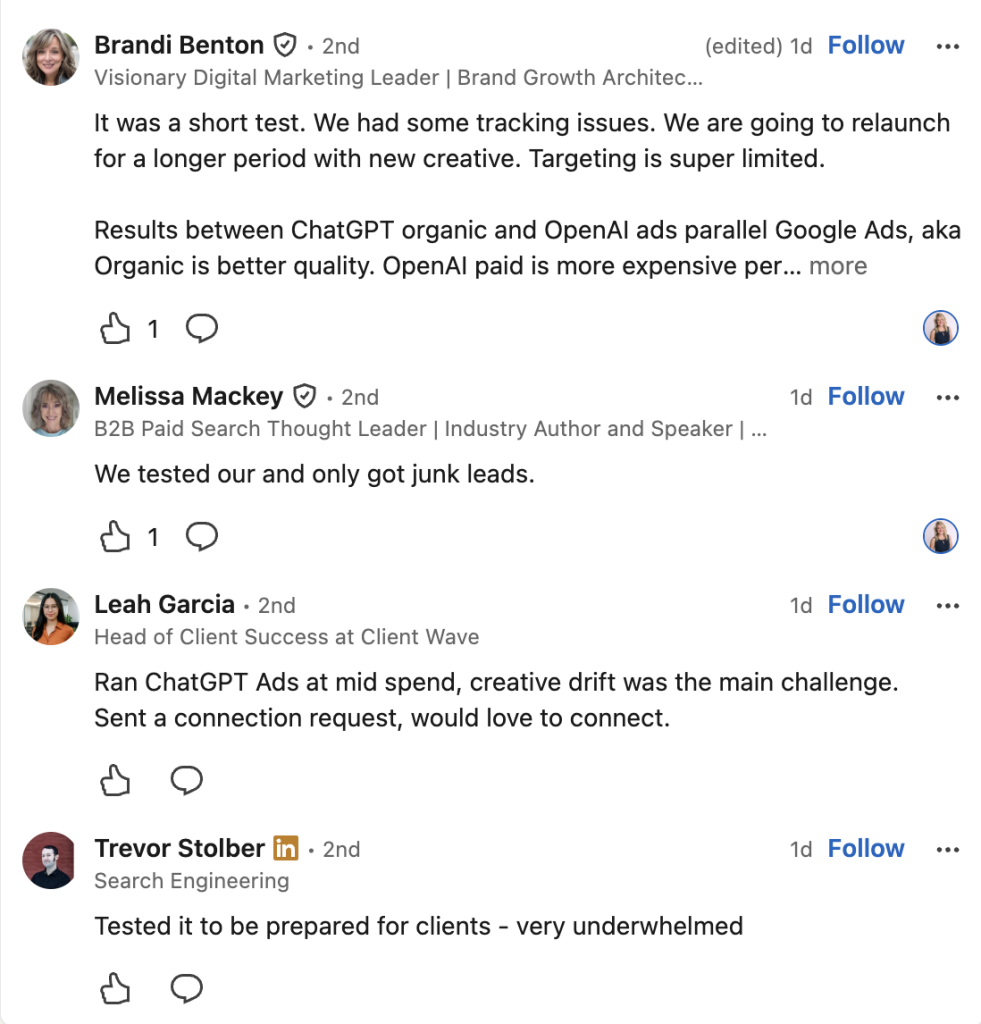
Brandi Benton ran into tracking issues during a short test and described targeting as “super limited.” She said acquisition quality was similar to Google Ads at a higher cost and with low volume. Her organic ChatGPT traffic produced better-quality acquisitions than the paid ads. She plans to relaunch with new creative and a longer test window.
Why some agencies are keeping small budgets
James Hamilton, co-founder of oakpool, a growth marketing agency and managed AI platform, said most clients in the agency’s ChatGPT Ads pilot are still spending. Oakpool has run campaigns since spring for clients in boutique hospitality, B2B services and entertainment. Hamilton said return on ad spend has been lower than on Google, but high enough to justify a small budget.
Hamilton said OpenAI’s conversion pixel has worked well for the hospitality campaigns, though he wants more detail over time. He did not share spend or returns by industry. He also said clients ask far more often about appearing in organic ChatGPT answers than about buying ads, and expects that balance to shift as the ad product matures.
Another agency advertiser said strong organic results persuaded some clients to try paid ads. Once those campaigns ran, some clients found the ads brought in inquiries for work the firm could not take on.
What advertisers got for their spend
An agency advertiser that asked to remain anonymous spent about $15,000 on its own ChatGPT Ads in the first month. Results were strong at first and then dropped off. The agency now spends about $800 a month and treats that budget more like branding. About half of the agency’s clients who tried ChatGPT Ads stopped and moved their budgets back to Google. That advertiser cited conversion tracking issues and said it was hard to see where ads appeared or why they showed up there.
A bankruptcy lawyer saw up to 20 conversions a month at a low cost per lead. After two months, however, the campaign had not brought in a single paying client. The inquiries related to the firm’s practice, but they fell outside the case types the lawyer wanted to accept. OpenAI’s pixel and Conversions API can connect form submissions to ads, but the firm’s intake notes would be the next place to check. If several callers expected a service the firm does not offer, the team would need to find out whether the ad or landing page created that impression.
Gil Gildner said approvals took weeks and sometimes months. His team broadened the campaigns to get them running. Clicks averaged less than $1 in the first week, but early delivery appeared to skew toward lower-income markets the client had not planned to prioritize. The client had approved a sizable test budget, and Gildner doubted it could be spent as planned. He still lacked a clear sense of what clicks would cost in the markets the client wanted to reach.
Why Google Search benchmarks can mislead
A working paper by Maximilian Kaiser and Christian Schulze examined 102 advertiser sites with full sales tracking. In the U.S., visits from ChatGPT Ads generated $0.89 in revenue per session, compared with $2.45 for Google Search ads. Those revenue figures do not include what advertisers paid for the visits.
OpenAI’s Evernote case study followed people who started a free trial. For the featured ChatGPT Ads campaigns, the trial-to-paid conversion rate was about 10% to 20% above Evernote’s historical paid acquisition average. The case study does not say what Evernote paid to acquire those subscribers or how many would have subscribed anyway.
Using a Google Search CPA target for ChatGPT Ads assumes the people reached are just as ready to act. Buyers who first see a product in a ChatGPT answer may not be ready to book a demo for weeks. A CPA check at the end of the first week can come too early to capture that delay. For B2B teams, tagging ad links separately from organic ChatGPT referrals can show when a prospect first arrived through an ad and later returned through Google to fill out a form.
How ChatGPT uses conversation context
OpenAI’s technical breakdown says its ad system uses earlier messages to understand what a user is trying to do. The system uses that context to find relevant ads and weighs relevance alongside bids. Even an ad that wins the auction may never appear. A B2B buyer might use ChatGPT to define feature requirements and then use Google to check vendor pricing, and research shows many people use both platforms. That overlap makes the path plausible, but it does not show whether an ad helped a vendor reach a shortlist.
OpenAI says advertisers do not see users’ conversations. A broad breakdown of the types of conversations where ads ran could help advertisers, if OpenAI can provide one while keeping chats private. A team seeing few demo requests could use that information to decide whether to build a comparison page for buyers still choosing features, or a page covering integrations and pricing for buyers already evaluating vendors.
What advertisers should check before spending more
ChatGPT Ads is still in its first year. Advertisers who ran Facebook ads early on have seen how much an ad platform can change, and comparing a first test with an account that has been refined for years can lead to dropping a campaign too soon. Some advertisers are already getting enough business to keep spending, but there is little evidence yet that those results will hold across more advertisers or at higher budgets.
Better delivery reporting and conversion tracking could give advertisers reasons to revisit paused tests. Until then, the best basis for a next budget is results an advertiser can follow through to a sale or a qualified opportunity, not a cost per acquisition from an account the advertiser has run for years.