

Secrets sprawl is leaving many leaked credentials active long after they are discovered. GitGuardian’s State of Secrets Sprawl 2026 research found that most valid secrets discovered in 2022 still worked in January 2026, four years later, because teams hesitate over what revoking a credential will break.
The findings point to a bottleneck that comes after detection. GitGuardian describes its platform as covering three connected capabilities: Detect, Remediate and Prevent. The company says detection is only the start, and that remediation is where many secrets security programs slow down. The article is the second in a series on those capabilities, following a piece on detection across every surface where credentials live.
Why secrets sprawl stalls remediation
GitGuardian argues that a team which finds an exposed credential rarely has the authority or knowledge to fix it safely. A security engineer can see that a key is valid and dangerous, but usually cannot immediately tell which services will fail if it is revoked. Breaking production is treated as a bigger risk than the possibility of a stolen secret being abused, so engineers go looking for answers, which takes time.
Developers who know where a key is used and how to rotate it safely are often busy with new features and business requests. An alert that shows only a file path and a secret type asks them to stop their work and run their own investigation. Those requests often end up in the backlog. The larger the organization, the harder it becomes to find the person who can answer the question of what breaks if a key is revoked.
Responsibility is split across several groups. Application security teams monitor the code where keys are used, identity and access management (IAM) teams govern the identities that were issued keys, and platform engineering teams run the vaults that hold them. Endpoint security teams are also starting to track secrets stored on workstations, since software supply chain attacks have increasingly targeted plaintext credential stores over the last couple of years. GitGuardian notes that the endpoint team is historically not connected to the AppSec or Platform teams. Each group sees only its own part of the credential layer, and that fragmentation multiplies across hundreds or thousands of potential leaks.
Prioritizing by impact instead of validity
Validity is the first signal most responders check, but GitGuardian says it is an incomplete one. Its research found that validity-only triage misses 46% of critical secrets, such as custom API tokens and SSH keys, because those secrets cannot be verified automatically.
GitGuardian recommends weighing what a credential can access. Access to sensitive data or core systems raises urgency, and a leak that happened publicly on the internet raises it further. The company also says a risk score should explain which factors drove it and should be updated as new context arrives. It compares a one-time score given at discovery to an initial CVSS score in a CVE disclosure: useful as a guide, but in need of revision based on what is happening inside the organization. Keeping that information centralized helps responders act quickly, especially when they reach the limits of the systems they can touch.
The contrast is easy to see with two valid cloud credentials. One grants read-only access to a single storage bucket. The other is a root-level key with administrative control over production. Their privileges and dependent workloads set how urgent each case is, but both still need the same investigation before a team can choose between rotating the key in the next sprint or revoking it immediately.
Routing remediation work to the people who can act
GitGuardian says remediation requests should let a developer or platform team act immediately, without repeating an investigation that has already been done. A request to replace a production key should include its validity, known exposure locations, dependencies and, where possible, how it connects to business operations.
In most enterprises, the request will not always reach its named owner. GitGuardian says teams may need to involve the developer who leaked the secret and gather data from commit attribution or source metadata. Communication matters because the person doing the work may need further instructions or guidance. Follow-up should also be collected centrally, so every department can see where a rotation stands. The company says this record helps demonstrate resilience when an auditor asks about it. Routing work through existing ticketing tools keeps it alongside other engineering tasks, and those tickets should connect with the security operations tooling used by responders.
Rotate, revoke and vault in the right order
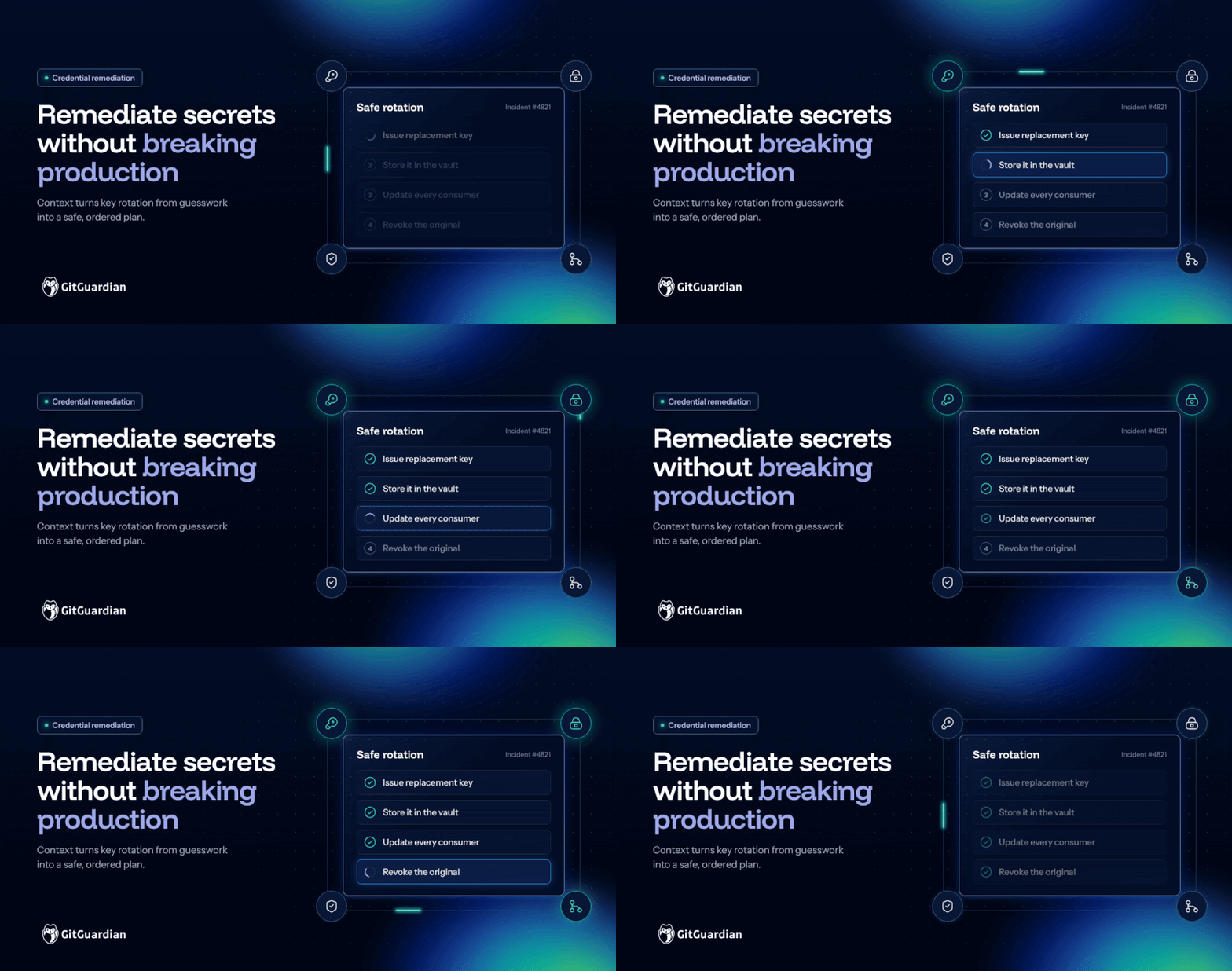
GitGuardian says safe rotation depends on following specific steps in the right order. Mature organizations that already pull credentials from a secrets manager can rotate the secret in the vault, since their applications already read it from there. Any plaintext copies become harmless once the original is revoked.
Where no vaulted copy is in use, the process starts with issuing a replacement credential. If the responder can do so, the company says they should do it immediately and store the new key in the vault. Every occurrence of the plaintext secret is then replaced with a vault call across all known consumers. The changed code or configuration is pushed live, monitored for problems and ready to roll back if something breaks. Only after all systems are safely using the new credential can the original be revoked. GitGuardian warns that getting these steps out of order turns a security fix into an incident. The company points to its service account credential rotation checklist for more detail.
Verifying the fix and keeping evidence
GitGuardian says a ticket should be closed only after the old key is revoked and the danger is removed. The organization should keep an audit trail showing what was fixed and how the fix was proven. That includes verifiable confirmation that the old credential no longer authenticates and, depending on the situation, evidence that the old secret was removed from every surface where it appeared.
GitGuardian also says incidents closed while the credential remains valid deserve their own review. This happens when a team rotates a key in one system while the old key stays active in another. The company says that gap usually comes from siloed tooling that lacks a unified view or relies on manual tracking. A complete incident record also helps auditors and security leaders see what was found, who acted and how long remediation took.
GitGuardian says it has helped thousands of developers and organizations streamline their remediation processes. Its example describes a Kubernetes application that calls an external service with an API key stored in a secrets manager. A developer copies that key into a local configuration file during troubleshooting and commits it, a scenario the company says it has seen many times. GitGuardian scanning detects the secret as soon as it is committed, and the platform opens an incident and alerts the assigned team. The rest of the example, including the remediation steps, is the next part of the company’s series.