

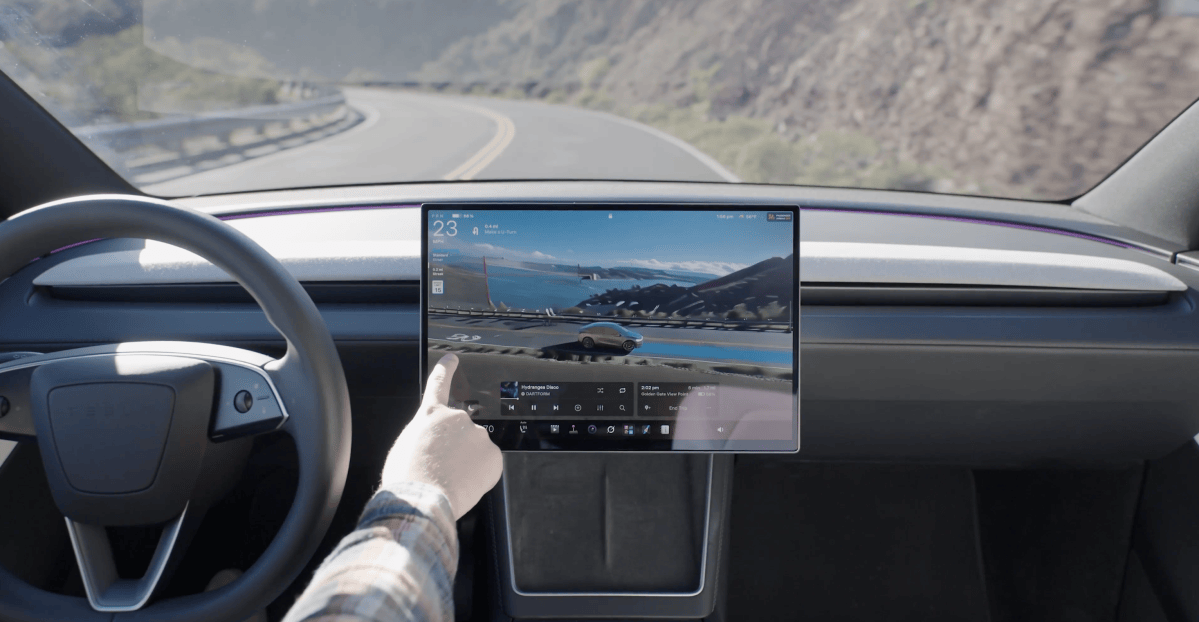
Tesla has begun rolling out FSD v15, a ground-up overhaul of its end-to-end driver assist system, Full Self-Driving (Supervised). The headline feature is Reality View, a real-time generative display that replaces the older wireframe graphics with a live overhead camera angle. Drivers can tap the screen to influence what the car plans to do next.
Reality View replaces wireframes with a photorealistic feed
Reality View uses a third-person perspective that renders buildings, crosswalks, pedestrians and surrounding traffic. Tesla’s display is designed to show the car’s surroundings in a much more detailed way than earlier wireframe visuals. Shortly after the update began rolling out on Saturday, the photorealistic look drew comparisons to Grand Theft Auto VI, which had launched only days earlier.
Elon Musk joined the comparison on X, posting “FSD is GTA irl.” The feed is shown on the center touchscreen, which raises an open question about whether the detailed view helps drivers understand what the car is seeing or whether it could pull attention away from the road.
For drivers who find the live feed overwhelming, Tesla includes a map-only option. It also offers a stripped-back “quiet mode” that reduces the amount of information on screen.
The AI model behind FSD v15
Under the hood, FSD v15 runs on an upgraded vision encoder. Tesla says the same encoder is shared across its FSD, Robotaxi and Optimus humanoid robot programs, which means improvements to the core vision system can carry across several products.
Tesla trained the model on millions of online videos. The company claims the AI learned to prevent serious driving mistakes 25 times more often while using less computing power. The figure is Tesla’s own claim and has not been independently verified in the information provided.
The update is built for vehicles with Tesla’s newer AI4 (HW4) hardware and for the upcoming Cybercab platform. Owners of older HW3-equipped cars will not receive the upgrade, which leaves millions of existing vehicles behind.
Practical upgrades in the FSD v15 release
Beyond the visuals, FSD v15 adds several features that affect everyday driving. The main changes include:
- Bike Rack Mode, which lets drivers engage FSD with hitch accessories attached. The mode disables reversing, Summon and Autopark.
- Automatic speed easing near traffic cameras, with an option to override it. Drivers can permanently mute specific cameras after two cancellations.
- Sharper hazard avoidance for potholes, standing water and small animals.
- Smoother speed handling in school zones and in bad weather.
Navigation can now learn preferred neighborhood routes and favorite parking spots over time. The cabin camera can also track driver attention while the driver wears hats or sunglasses, and it reduces nagging alerts at higher speeds.
Safety questions and the NHTSA investigation
Tesla’s “25x” safety claim comes as the National Highway Traffic Safety Administration (NHTSA) actively investigates roughly 2.9 million FSD-equipped vehicles. The probe covers reports of Teslas running red lights, crossing railroad tracks improperly and driving into oncoming lanes.
The investigation sits alongside dozens of cumulative fatalities linked to Tesla’s driver-assistance systems since 2019. Tesla has faced criticism over how well its system keeps drivers alert, and the new cabin camera features are meant to address that concern. FSD in its current form still requires a human driver to keep their eyes on the road.
Tesla has not said how many vehicles will receive FSD v15 or when the rollout will reach every eligible car. The NHTSA probe remains open, and it is not clear whether the new software will change its scope.