

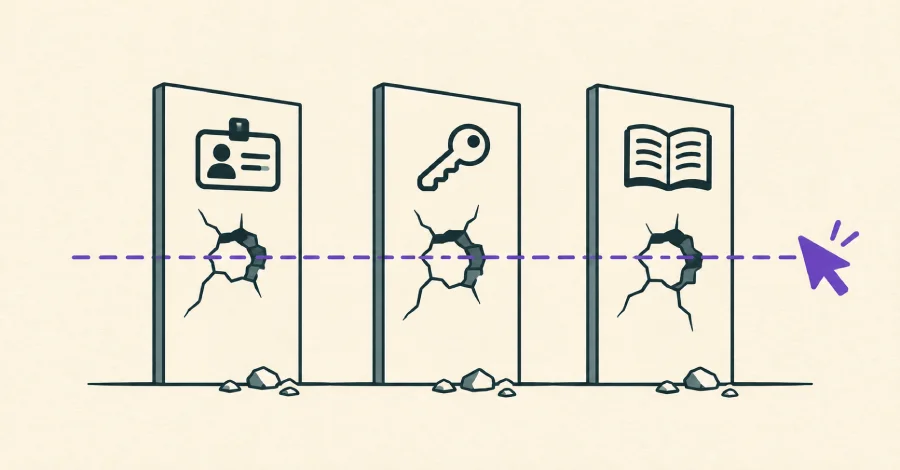
Token has built a browser agent that broke all three of the security rules the company tells its customers to follow, and the team says the exercise shows how companies should control agent access. The browser agent, named Rehearsal, was designed to work inside the Token platform, and it broke the rules by default. The company said the experiment is now shaping how it thinks about defending agents that act inside a user’s authenticated session.
Token’s guidance for securing AI agents rests on three principles. Agents need their own identities. Their access should match the specific job they are given. And their activity should be traceable separately from any human’s. The company said those principles also applied to its own systems, until the test showed how easily they could fail.
How the Rehearsal browser agent was built
Rehearsal answers questions inside the Token platform by carrying out tasks instead of only describing them. It opens pages in the browser tab, sets filters and fills in forms on its own. From a security standpoint, Token describes it as a typical UI agent that runs in the user’s browser, which is the source of its usefulness.
The same design creates the risk. The browser agent runs inside the user’s session and has the user’s reach. Token said that a server receiving the agent’s clicks cannot tell them apart from the user’s clicks, because a session cookie does not identify who is actually driving the session.
Why the application cannot see the browser agent
When a browser agent acts inside an authenticated session, the application may see the user but not the agent, the delegation behind the action, or the intended scope of the task. That gap is the core problem Token ran into. An application that logs activity under the user’s name has no direct record that an automated tool made the change.
Token said the gap is not limited to its own product. Any browser agent driving a customer relationship management system or a cloud console would face the same blind spot. The application cannot detect the agent, and the agent cannot easily tell which field holds a secret or which button deletes a record.
What controlling both sides made possible
Because Token owns both the agent and the application it runs in, the company could close these gaps from the inside. Token knows who is driving a session because Rehearsal reports that information to the platform. Token said that is an advantage most outside developers do not have.
The company listed several practices it applied when it controls the agent itself:
- While the agent moves, dim and lock the application and clearly indicate who has control.
- Record every move in each session, including actions that were blocked.
- Limit the agent’s reach to less than the user’s own. Rehearsal can only read dashboards, cannot save anything without the user’s approval, does not fill in secret fields and never sends a call the platform has refused.
- Let the agent read dashboard controls through the page’s accessibility labels.
Token said these measures work for its own agent only because that agent relies on access no outside agent has. Its approach cannot be copied directly by other developers or by companies deploying third-party agents.
Gaps in current browser and web standards
Token said the web is starting to build separate lanes for agents, but the efforts are not yet joined together. Chrome’s auto-browse feature asks a person to approve high-stakes actions such as payments or mass emails, limits the agent to sites the task needs and tags pages the agent visits in the user’s history. Microsoft lets administrators enable agentic browsing per site and pause it before passwords and card numbers are entered.
Other efforts focus on the application side. WebMCP is a draft being written by Google and Microsoft in a W3C community group. It lets a site expose actions that an agent can call directly, and it marks each action as read-only or consequential. Web Bot Auth, now an IETF working group draft, allows a site to verify which agent sent a request.
Token argued that none of these lanes passes context to the others. Chrome and Edge do not describe how a browser should tell the application that an agent is driving. A WebMCP tool runs with the user’s rights, so it does not by itself narrow what the agent can reach. Web Bot Auth identifies the agent but does not cover delegation, so it leaves out the person the agent works for. The company said that means the application ends up with fragments of context instead of information it can act on.
Token said every lane built for agents should carry three things: the agent’s identity, a verifiable link to the person it acts for, and a scope narrower than that person’s permissions. Without them, Token warned, faster agent lanes simply create faster routes for misuse of privilege.
Steps security teams can take before standards arrive
Token said security teams cannot wait for standardization. It recommended starting to discover agentic browsers and extensions now, including the users whose sessions they borrow. Because a security team cannot always tell who clicked, it can decide which clicks require a person by adding a step-up check, such as a passkey prompt.
The company listed specific actions for security teams:
- Inventory browser agents, agentic extensions and endpoint agents that can act through authenticated sessions, and map each to its users and owners.
- Trace every AI agent consumer to identify which people and other agents use each agent.
- Review every identity that each agent can access.
- Identify possible attack paths that use agents to bypass access controls.
- Require explicit approval or step-up authentication before sensitive or irreversible application actions.
- Ask critical SaaS vendors whether their audit records separate agent activity from human activity and whether they support task-scoped delegation.
Token’s conclusion for now is that companies should treat any agent using a human session as delegated access that must be discovered, constrained and audited. That approach applies until browsers and applications can carry agent identity, human delegation and task scope together.